
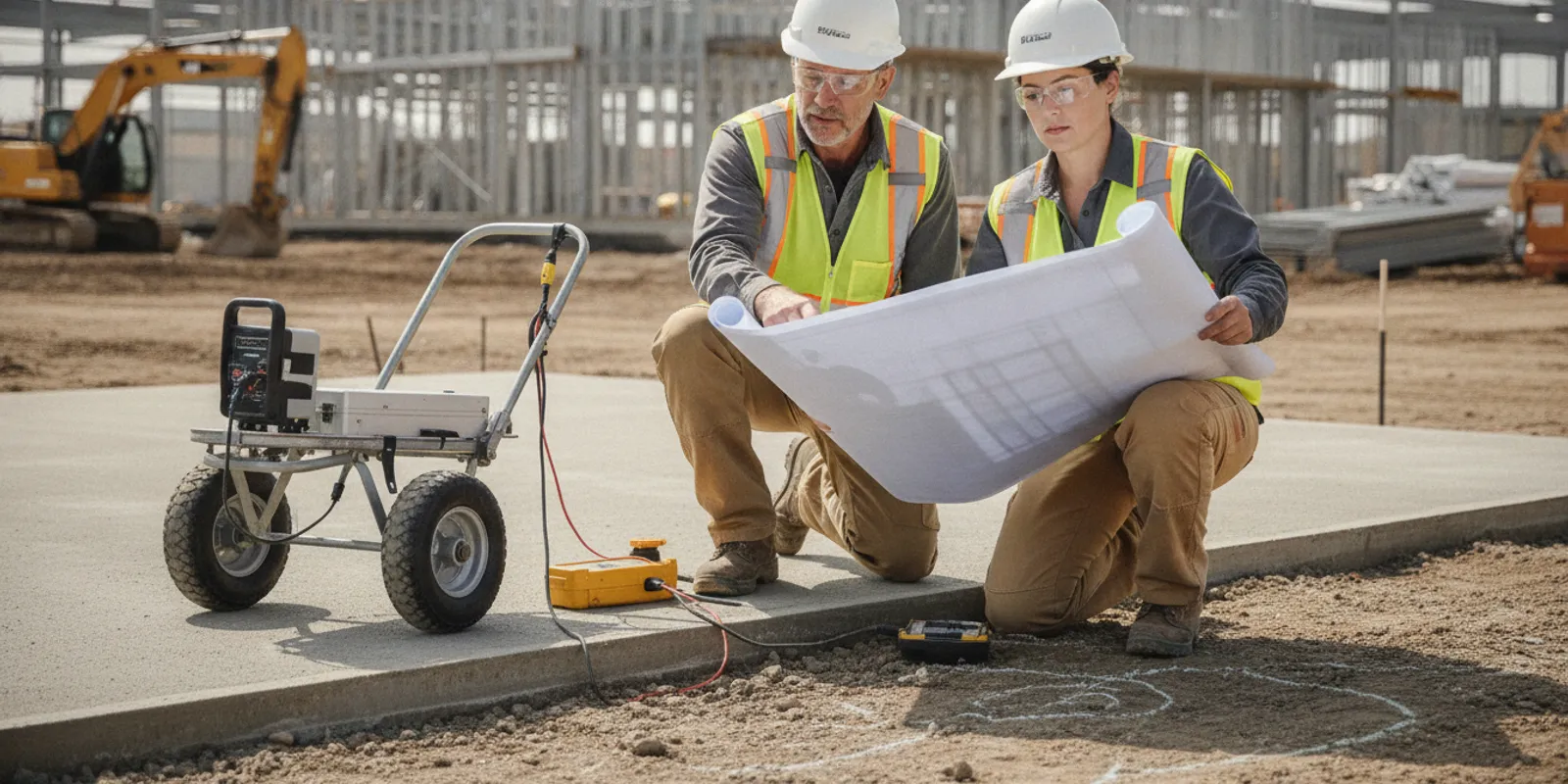
Choosing among concrete scanning companies is about more than finding someone with a scanner. Before you hire, confirm the company understands the work area, uses a method suited to the question, explains limitations, and provides results your crew can act on. For a drilling or renovation project, those details help you plan the next step instead of relying on an unexplained mark on a slab.
Need broader buried-utility locating alongside a concrete project? Use SafeLine's contact form to request a scope review for private utility locating or mapping.
This guide is an independent checklist for evaluating providers. SafeLine Subsurface does not provide concrete scanning. The company provides private utility locating, GPR, subsurface utility engineering (SUE), and underground utility mapping. If your project also needs information about buried site utilities beyond a concrete structure, you can review SafeLine's utility locating and mapping services and confirm scope before requesting help.
What should you compare among concrete scanning companies?
Start by defining the decision the scan needs to support. A contractor preparing a small number of anchor holes may need a different deliverable and schedule than a facility manager planning many penetrations across an occupied building. A vendor should be able to discuss the specific area, the proposed work, the access available, and the information you need before anyone promises what a scan will find.
Compare providers across the same categories rather than choosing from a headline claim or a price alone. Ask each company to describe its method, relevant project experience, field procedure, reporting, limitations, safety planning, and schedule. Then compare the answers side by side.
| What to compare | Questions to ask | What a useful answer includes |
|---|---|---|
| Project fit | Have you handled this type of structure and proposed work? | Relevant examples and clear questions about the work area and decision. |
| Method | What method will you use, and why is it suitable here? | A plain-language explanation of capability and limits for the material and target. |
| Field procedure | How will you scan and communicate findings on site? | Defined coverage, orientation or grid approach where applicable, and coordination with the crew. |
| Deliverable | What will we receive, and when? | Agreed marking and/or documentation, with findings and limitations identified. |
| Safety and access | What access or site controls do you need? | Advance discussion of occupancy, restricted areas, work sequencing, and applicable controls. |
| Schedule and scope | What affects the price and turnaround? | Assumptions, included areas, exclusions, and conditions that could change the work. |
Before comparing estimates, make sure each one describes substantially the same scope. One quote may cover a single location and field marks; another may include a larger survey area, written documentation, or a return visit. A lower number is not necessarily a better comparison if the listed work differs.
It can help to make a short comparison sheet for each bidder. Record the covered area, proposed method, number of locations, access assumptions, reporting format, timeline, exclusions, and the person responsible for answering questions. If a proposal leaves a category blank, ask for clarification rather than treating the omission as included work. This simple step makes scope differences visible before a crew is waiting on site.
How do concrete scanning companies choose a method?
Ask a prospective provider to connect the method to the object or condition you need to investigate. Ground penetrating radar (GPR) sends electromagnetic energy into a material and interprets returning signals. In concrete, a qualified operator may use it to look for changes associated with embedded features such as reinforcement, conduits, or post-tension elements. The result is an interpretation, not a guarantee that every object is visible or identified.
Some providers also use electromagnetic locating equipment. EM methods can help detect conductive, energized, or otherwise traceable targets depending on the equipment, setup, and conditions. They are not interchangeable with GPR, and they do not reveal every nonmetallic or untraceable feature. A provider should make clear which instrument is being used, what it can reasonably answer, and what it cannot establish.
Radiographic methods, often referred to as X-ray, are another possible approach for certain concrete investigations. They involve a different setup and safety considerations than GPR. Ask the company to explain why it recommends one approach over another for your specific target, access conditions, and work plan. Avoid choosing a method solely because it is described as the most advanced.
Concrete scanning and underground utility locating are related only in the broad sense that both investigate hidden conditions. Scanning within a concrete element is not the same scope as locating buried utilities in soil, pavement, or a wider site. A project can require both, but the proposal should state which areas and questions are included. For broader buried-utility work, SafeLine describes its investigation methods and deliverables on its investigation process page.
When evaluating a method recommendation, ask what information the operator needs from you and what could make the result less conclusive. Existing plans, known reinforcement, prior repairs, surface coverings, access to the opposite side, and the exact proposed penetration locations can all help shape the investigation plan. Ask the vendor to distinguish what is known from what will be inferred in the field.
How can you evaluate relevant experience?
Ask for examples that resemble your project in useful ways: type of structure, approximate work area, target, access, and the decision the scan supported. The goal is not to collect a list of impressive project names. It is to understand whether the provider has encountered similar conditions and can communicate uncertainty responsibly.
Discuss who will perform the fieldwork and interpret the data. Ask about operator training and experience with the proposed equipment and task. If the provider refers to a certification, license, or quality program, ask what it covers and whether it applies to the work being quoted. Do not assume that a general credential automatically proves proficiency with a particular material or detection problem.
Questions that help reveal the provider's approach include:
- What comparable projects have you completed, and what made them comparable?
- Who will be on site, and who will review or explain the findings?
- How do you handle areas where signals are unclear or conditions restrict coverage?
- What do you need from our drawings, site contact, or construction team before arriving?
- Can you provide a sample of the type of documentation included, with client details removed?
A thoughtful provider may ask you for additional details before confirming scope. That is useful. They may need to know the planned hole or cut locations, the concrete area involved, access from one or both sides, finishes or coverings, and whether operations will continue nearby. If a vendor guarantees detection without discussing the question, site conditions, and limitations, ask for the basis of that assurance in writing.
Listen for how the company describes a difficult or inconclusive project, not only its successful examples. A credible explanation should identify what was investigated, what limited the work, what the crew reported, and how the client used that information. The provider should not disclose confidential client details to demonstrate experience; an anonymized example or sample report may be enough to show its process and communication style.
What should the field process include?
Ask how the provider will translate the work plan into field coverage. For example, will the team investigate only the proposed penetration points or a defined surrounding area? How will the scan locations be identified and communicated? What happens if the requested area is obstructed, inaccessible, or different from the information supplied in advance?
Discuss coordination before the crew mobilizes. The scanning team may need a clear work area, access permissions, a site escort, an agreed time window, or coordination with other trades. Confirm whether furniture, equipment, stored materials, or surface finishes need to be moved by your team. Clarify whether the provider is expected to work around an occupied space or active construction activity.
At the end of fieldwork, ask how findings will be transferred to the people making the drilling or cutting decision. Are marks intended to be temporary? Will the crew explain how to interpret them? If there are multiple locations, will they be labeled consistently? These questions help prevent an avoidable handoff problem between the person who performed the investigation and the person who will act on it.
Keep the proposed work coordinated with the appropriate project personnel. A scan report or a mark should be treated as information for planning, not permission to proceed regardless of other site requirements. Confirm the work plan with the responsible engineer, construction supervisor, facility representative, or other qualified professional when needed.
Before the appointment, name one person who can make access decisions and answer field questions. Confirm how the provider should handle a location that differs from the drawings or cannot be scanned as planned. A clear escalation path keeps the field team from making assumptions and helps the project lead decide whether to revise the work area, gather more information, or pause for review.
What deliverables should be included?
Do not accept an undefined promise to "scan the area." Agree on the deliverable before work begins. Depending on the scope, a company may provide field markings, photographs, a written summary, a marked-up plan, or another record. Ask exactly what is included, how locations will be referenced, and how the findings and areas of uncertainty will be described.
A useful report or handoff should be understandable to the crew that needs it. Ask whether the company will document the investigated area, the requested target or question, the method used, and any limitations or inaccessible sections. If you require a digital file, a drawing overlay, or a particular naming convention for project records, state that up front and confirm the format is available.
Also clarify what the deliverable does not mean. A detected indication may require interpretation; a feature that was not identified is not automatically proof that no obstruction exists. The provider should explain how its findings relate to the planned work and what further review may be appropriate. Be wary of language that treats every scan as a complete, definitive picture of everything embedded in the structure.
For a project that extends beyond the structure into the surrounding site, keep the records and scopes distinct. Concrete investigation does not by itself provide a map of buried utilities outside the slab. If your project needs broader subsurface documentation, review the separate utility mapping and documentation scope and ask the provider what area and features it addresses.
Check that field marks and records use a location reference your team can reproduce. A note such as "near the east wall" may be unclear after equipment moves or another trade takes over. A drawing reference, labeled photo, or agreed grid can make a finding easier to relate to the planned work. Confirm how the deliverable will be shared and who receives it so that the information reaches the crew before work proceeds.
How should you compare price and schedule?
Ask for a written estimate that identifies the area, number or type of locations, method, expected field time, deliverables, and assumptions. Price can vary with the size and complexity of the work, access, number of investigation points, required documentation, urgency, and site constraints. These factors make a general price comparison unreliable unless the quotes use a comparable scope.
Confirm what could affect the quoted amount or completion time. Is the estimate based on drawings or measurements you supplied? Does it assume clear access? Does it include mobilization, after-hours work, travel, or a return visit if access is unavailable? How quickly will the company provide any promised report after fieldwork? Make sure any exclusions are clear before approving the work.
Schedule matters, but a rapid appointment is only useful if the team can access the work area and deliver findings in time for the decision. Tell the provider when the work is planned, what other trades are involved, and when your team needs the information. Ask whether there is a deadline for submitting site information or preparing the area. For a time-sensitive project, get the proposed arrival and reporting timeline in writing.
Compare the full sequence, not only the proposed site visit. A provider may need plans or photos in advance, a site contact to confirm access, and time to prepare a report after fieldwork. Ask whether an estimate assumes the area will be ready on arrival and what happens if the work is delayed by access restrictions. A realistic schedule accounts for the time your team needs to review results before drilling, cutting, or changing the plan.
What limitations and safety practices should you discuss?
Conditions can affect what an instrument detects and how confidently a result can be interpreted. Congested reinforcement, depth, material variation, moisture, surface conditions, access, and nearby objects may affect a scan. The exact impact depends on the site and method, so ask the provider to identify relevant constraints rather than relying on a generic disclaimer.
Ask how the team will communicate an inconclusive result. Will the field technician mark an area as uncertain, recommend another method, request additional access, or identify a need for professional review? Establish who on your team has authority to decide whether the planned work changes. A responsible process makes uncertainty visible rather than turning it into an informal assumption.
Discuss safety controls relevant to the method and site. If a radiographic approach is proposed, ask the provider to explain the applicable safety planning and how the work area will be controlled. For any method, confirm site access, coordination with occupants and trades, and any requirements your facility or project team must meet. Do not infer that one method has no safety or operational considerations simply because it is non-destructive. For general federal workplace safety information and resources, consult the Occupational Safety and Health Administration (OSHA) and coordinate site-specific controls with the responsible safety personnel.
Keep a copy of the agreed scope and final documentation with project records. If the work area, proposed penetration, or schedule changes after scanning, tell the provider and responsible project personnel. A changed plan may require a new review; a result tied to one location should not be casually applied to a different one.
What are common warning signs when selecting a provider?
- Unqualified guarantees: The company promises a perfect result without asking about the target, site, or method limits.
- Vague scope: The quote says only "scan concrete" without defining locations, access, method, or output.
- No clear handoff: The provider cannot explain how findings will be marked, documented, or communicated to the crew.
- One-size-fits-all method: The company recommends the same approach for every material and target without explaining why.
- Unclear safety plan: The company cannot describe how it will coordinate its method and work area with the site.
- Pressure to proceed: The provider urges work to continue despite an uncertain result or a mismatch between the scanned area and proposed work.
One warning sign does not automatically tell you what happened, but it is a reason to ask more questions and get the answer in writing. You should be able to understand what the company proposes, what you will receive, and what remains outside the scope before authorizing the work.
What should you send when requesting a proposal?
A concise project brief helps providers respond with a more relevant scope. Include the site address, structure or surface type, the planned work, approximate locations and dimensions, project timing, access details, and the deliverable you need. Attach drawings or photos if available, and identify a site contact who can answer questions about access and coordination.
Use this checklist when requesting proposals:
- State the decision the investigation must support, such as evaluating proposed penetration locations.
- Mark the relevant areas on a plan or photo, and describe how many locations are involved.
- Describe the structure, access, surface covering, and any known constraints.
- Explain the work schedule and when findings need to be available.
- Specify whether you need field marks, photographs, written documentation, or a particular file format.
- Ask the provider to identify its proposed method, limitations, assumptions, exclusions, and any follow-up it expects.
For projects involving buried utilities outside the concrete area, use a separate scope and request the relevant locating or mapping information. SafeLine's contractor subsurface resource describes its focus for construction teams, while the SafeLine FAQ can help clarify the company's service scope. You can also review how private utility locating differs from 811 when planning excavation beyond the structure.
Need private utility locating or mapping for the surrounding site? Use SafeLine's contact form to request a scope review.
Frequently asked questions
Do all concrete scanning companies use the same method?
No. Providers may use different instruments or combinations of methods. Ask what method is proposed for your target and why it fits the material, access, and decision you need to make.
Does a concrete scan confirm that an area is safe to drill?
A scan provides information about the investigated area; it is not a blanket guarantee or authorization to proceed. Have the responsible project professional review the results and confirm the work plan, especially if findings are unclear or conditions have changed.
Should I request field markings or a written report?
Choose the deliverable based on who will use the information and how. A crew working at marked locations may need clear field communication, while a facility or project team may also need photos, a plan, or a written record. Agree on the format and coverage before hiring.
Can one concrete scan locate buried utilities across the property?
Not necessarily. Concrete scanning and broader private utility locating address different areas and questions. If work extends into the surrounding ground, ask for a separate scope that identifies the buried utilities and site area to be investigated.
Does SafeLine Subsurface provide concrete scanning?
No. SafeLine provides private utility locating, GPR, SUE, and underground utility mapping, but does not provide concrete scanning. For a project that needs information about buried site utilities, contact SafeLine to discuss whether its services fit the scope.
Choose a provider whose proposed method, experience, limitations, safety planning, schedule, and deliverables match the work you need to complete. A clear scope and a careful handoff give your team a more useful basis for planning the next step.