
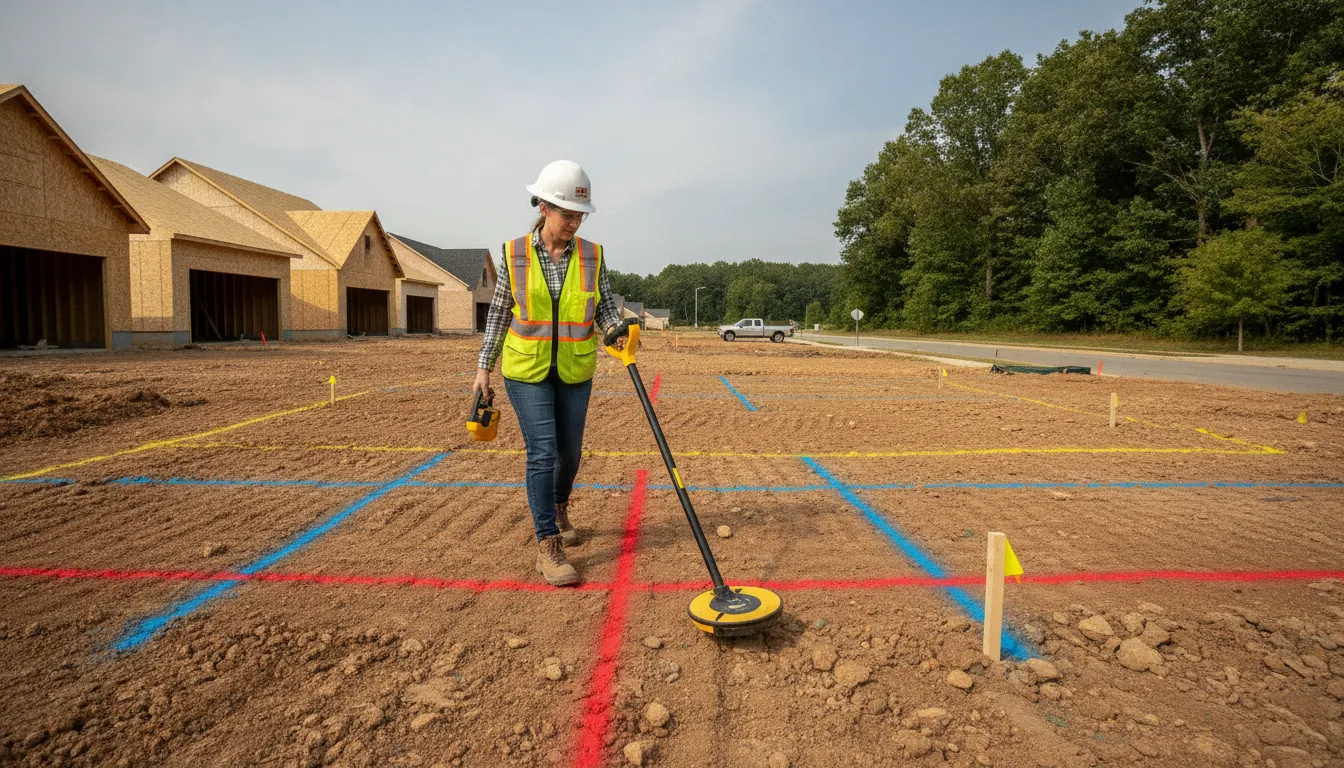
A utility mark on the ground is not a complete map of everything buried beneath a property. The 811 notification process is an essential first step before digging, but its public markings generally cover facilities owned and maintained by utility operators, often only to the meter or property-line boundary.
Private utility locating is a separate field service that investigates privately owned underground lines 811 may not mark, such as irrigation, pool, lighting, and outbuilding connections. It complements, but never replaces, the required 811 notification, helping property owners and contractors plan excavation with a more complete site picture.
That distinction matters whether you are planting trees, installing a fence or pool, setting foundations, or planning a larger excavation. For a practical comparison of the two locating steps, review SafeLine's private locating versus 811 guide.
Why 811 Is the First Step, Not the Whole Locate
Calling 811 before digging is an essential safety step for homeowners, contractors, and excavators. The one-call process helps notify utility operators about planned excavation so the facilities they own and maintain can be marked. Safety guidance consistently recommends contacting 811 before any digging project, even when the work appears small or the property is familiar. Learn more about calling 811 before you dig.
What the public locate usually covers
The public marking process is tied to utility ownership. Utility operators generally mark the lines they own and maintain, which often means the service runs up to a meter or another defined property boundary. That scope can be appropriate for identifying public gas, electric, water, or telecommunications facilities, but it does not necessarily represent every buried line across a lot.
| Locating step | Primary purpose | Important limit |
|---|---|---|
| 811 notification | Coordinate marks for participating utility facilities. | May not include private lines beyond the operator's responsibility. |
| Private utility locating | Investigate private lines and buried assets in the project area. | Does not replace 811 or safe excavation practices. |
Once a line crosses beyond the operator's responsibility, the marking obligation may end. Private water or sewer laterals, irrigation systems, underground lighting, detached-building services, and other owner-installed facilities can remain outside the public locate. The exact boundary depends on the utility, site, and local rules. A clear 811 response should be treated as information about the facilities covered by that response, not confirmation that the entire property is clear.
Why a second locating step may be needed
After 811 has been contacted and the public marks are visible, review the planned excavation area for privately owned utilities and site-specific risks. A project that stays close to a house, crosses a driveway, reaches a detached structure, or extends past a meter may involve lines that the public utility operator does not own. The same concern applies to landscaping, fencing, pool installation, deck construction, and other work that disturbs soil on private property.
That is where private utility locating can complement the 811 process. A private locator can assess areas and buried assets outside the public marking scope. The locator selects field methods for the site and utility type. For a lasting record of findings, SafeLine also offers utility mapping and documentation. This does not replace 811. It adds another layer of information before excavation begins.
Keep the sequence simple:
- Contact 811 and follow the applicable notification requirements.
- Wait for the public locate to be completed and review the marks.
- Determine whether private locating is appropriate for the remaining work area.
- Keep the markings and documentation available while the work is planned.
What Private Utility Locating Covers on Your Property
Private utility locating identifies underground lines owned by a property owner, contractor, developer, or other private party rather than by the public utility company. These lines can be just as important to protect as public gas, electric, water, or telecommunications facilities. They may not be included in public utility marks.
Where public utility locating typically stops
Calling 811 remains the first step before any digging project. The public locating process generally covers facilities that utility operators own and maintain. In many situations, that responsibility extends to the meter or a property-line boundary, not every buried line serving the structures and improvements on the property. Blue Stakes explains the public and private utility distinction.
The exact boundary can vary by utility, property, and jurisdiction, so a private line should not be assumed to be excluded or included without checking the project requirements. A completed 811 ticket is not a complete map of every underground asset on a private site.
Examples of lines a private locate may identify
Once a line continues beyond the public utility boundary, it may serve a private improvement or connect equipment that the utility operator does not own. Depending on the site and local ownership rules, a private locating scope may include:
- Irrigation supply lines and control wiring
- Pool equipment lines and electrical feeds
- Landscape lighting and low-voltage systems
- Private feeds to an outbuilding or garage
- Private water or sewer laterals
- Owner-installed lines between site improvements
These examples are not a universal exclusion list. Ownership and marking obligations differ, and some facilities may be covered by the utility, the municipality, or another party. A qualified locator reviews the site, available plans, visible access points, and the planned excavation area before determining what can be investigated.
Why the distinction matters before excavation
A landscaping, fencing, pool, deck, or construction project can cross areas where private lines were installed years earlier and are no longer obvious from the surface. Without field verification, a contractor or homeowner may have marks for public utilities but no clear indication of privately owned infrastructure. SafeLine's private locating services help investigate that additional scope using methods selected for the site. Private locating supplements 811. It does not replace the required one-call process.
When Should You Schedule a Private Utility Locate?
Schedule a private utility locate before any project that will disturb soil or require drilling, trenching, grading, or digging on your property. Calling 811 remains the required first step before excavation. However, the public one-call process generally marks facilities owned and maintained by utility operators, often only up to the meter or property boundary. A private locate complements 811 by looking for privately owned lines and other buried assets that may continue across the site.
Residential projects that need a locate
Homeowners should arrange private utility locating before work such as landscaping, fence-post installation, pool construction, deck footings, irrigation changes, or excavation for an addition. The same recommendation applies whether the project is being completed by a homeowner, landscaper, pool installer, fencing contractor, or general contractor. A line that is not marked during the 811 process can still be present in the planned work area, especially when it serves a private structure or extends beyond a utility meter.
- Call 811 and follow applicable waiting and marking requirements before digging.
- Review site plans, previous surveys, utility records, and visible service routes.
- Identify the exact areas where posts, footings, drains, pools, trees, or improvements will be installed.
- Schedule a private locate for suspected private lines or areas that 811 does not mark.
- Keep markings and field documentation available for the crew performing the work.
Commercial, development, and engineering triggers
Contractors and excavators should schedule the locate during site planning, before finalizing excavation limits or mobilizing equipment. Commercial site work, building additions, utility modifications, grading, road work, and facility improvements can affect a larger and more complicated subsurface area than a typical residential project. Facility managers should also consider a locate before repairs, upgrades, or maintenance work that involves unmarked portions of a campus.
Developers, civil contractors, and engineers may need private utility locating as an input to subsurface utility engineering, or SUE. Large infrastructure work benefits from professional field information before design decisions and construction activities are locked in. The scope may include locating, documenting, and communicating subsurface conditions so the project team can plan around known risks. The appropriate level of investigation depends on the site, design, and project requirements, so discuss the scope with the locating provider early.
For any project, do not treat a private locate as a replacement for 811. Use both processes, then respect the markings, site conditions, and qualified direction provided for the work. SafeLine's private locating services can help project teams identify the right next step for their site. Homeowners can also review SafeLine's guidance for homeowners planning excavation projects.
How GPR and EM Locating Work Together
Different underground utilities create different locating challenges. A private utility locating professional may use more than one method because a single technology is not equally suited to every buried target or site. SafeLine combines ground-penetrating radar (GPR) with electromagnetic (EM) locating to investigate a broader range of subsurface conditions, then documents the findings for the project team.
Matching the method to the buried target
EM locating is useful for conductive or metallic lines. The method can help technicians investigate utilities that respond to an electromagnetic signal, such as metallic infrastructure or conductive lines. GPR takes a different approach by sending radar energy into the ground and interpreting subsurface responses. It can help investigate non-conductive or plastic targets that may not respond to EM locating.
That distinction is important, but it is not a promise that either method will find every utility in every setting. Soil composition, ground moisture, surface conditions, utility construction, interference, and access can affect what technicians observe. Method selection should follow the property and the work, rather than a one-size-fits-all assumption. SafeLine uses this complementary GPR and EM approach for private locating.
From field signals to usable site information
Locating is more than detecting a signal and drawing a line. Technicians assess field marks alongside evidence gathered from equipment and visible property features. They may record observations with verification photos and site maps. This gives contractors, engineers, and property owners a clearer record of what was investigated and where indications were identified.
Careful interpretation matters because subsurface conditions are not visible in the same way as above-ground assets. A mark or radar response needs to be considered in context, and field documentation should describe the result without overstating certainty. This is especially important when a project involves excavation near existing infrastructure or when a buried line does not fit the assumptions suggested by available plans.
Why both technologies support safer planning
GPR and EM locating work together as complementary tools, not as replacements for the required 811 process. Call 811 before digging, every time. That public process addresses utility facilities owned and maintained by participating operators, while privately owned lines may require a separate investigation. The Washington Utilities and Transportation Commission emphasizes calling 811 before excavation.
Once the 811 process is underway, a site-specific private utility locating assessment can help address the remaining questions. Combining appropriate field methods with marks, photographs, and mapping gives the project team information to use during planning and excavation. The goal is not to offer a blanket detection guarantee. It is to improve the quality of the subsurface picture and support better-informed decisions before ground is disturbed.
Explore SafeLine's private utility locating service before scheduling excavation or other ground-disturbing work.
Call SafeLine at 1-866-677-2335 for a private utility locating quote
Frequently Asked Questions
Does calling 811 replace a private utility locate?
No. Calling 811 is the required first step before digging, but the one-call process generally covers utility facilities owned and maintained by public operators. Lines on private property may extend beyond the utility meter or may not be connected to a meter at all, so they can require a separate locate. Follow the 811 process and confirm what the utility operators marked before work begins.
What does 811 typically mark?
811 typically coordinates marking for underground facilities owned and maintained by participating utility operators, often up to the meter or property boundary. It does not automatically identify every buried line, conduit, irrigation system, or other privately owned asset on a property. Follow the 811 process and confirm what the utility operators marked before work begins.
When should a property owner schedule private utility locating?
Schedule it before projects that involve digging, such as installing a pool, fence, deck, or landscape features. It is also appropriate for contractors, excavators, developers, and facility managers when plans may cross privately owned utilities or when existing site records are incomplete. A professional locate can add field information before excavation starts.
How are private utilities located?
The method depends on the suspected utility and site conditions. SafeLine combines electromagnetic locating for conductive or metallic lines with Ground Penetrating Radar for non-conductive or plastic targets. Using complementary methods can help investigate different types of buried infrastructure, but it does not replace careful planning, 811 notification, or safe excavation practices.