
.
Before drilling, coring, cutting, or demolishing concrete, the safest first step is understanding what may be hidden below the surface. Ground Penetrating Radar (GPR) is a rapid, nondestructive testing method that sends electromagnetic pulses into concrete and interprets reflections from changes in the material.
So, what can gpr detect in concrete? GPR can help locate and map rebar, post-tension cables, conduits, and other embedded objects, while also indicating changes such as voids, honeycombing, delamination, or varying thickness. Results are site-dependent, however. Moisture, concrete composition, reinforcement congestion, target size and orientation, antenna frequency, surface conditions, depth, and access can all affect visibility.
GPR does not guarantee that every target will be found or identified, and it works differently from electromagnetic (EM) locating, which is useful for conductive lines. Understanding how GPR reads those reflections is the starting point for using scan results responsibly on a real project.
How GPR Sees Inside Concrete
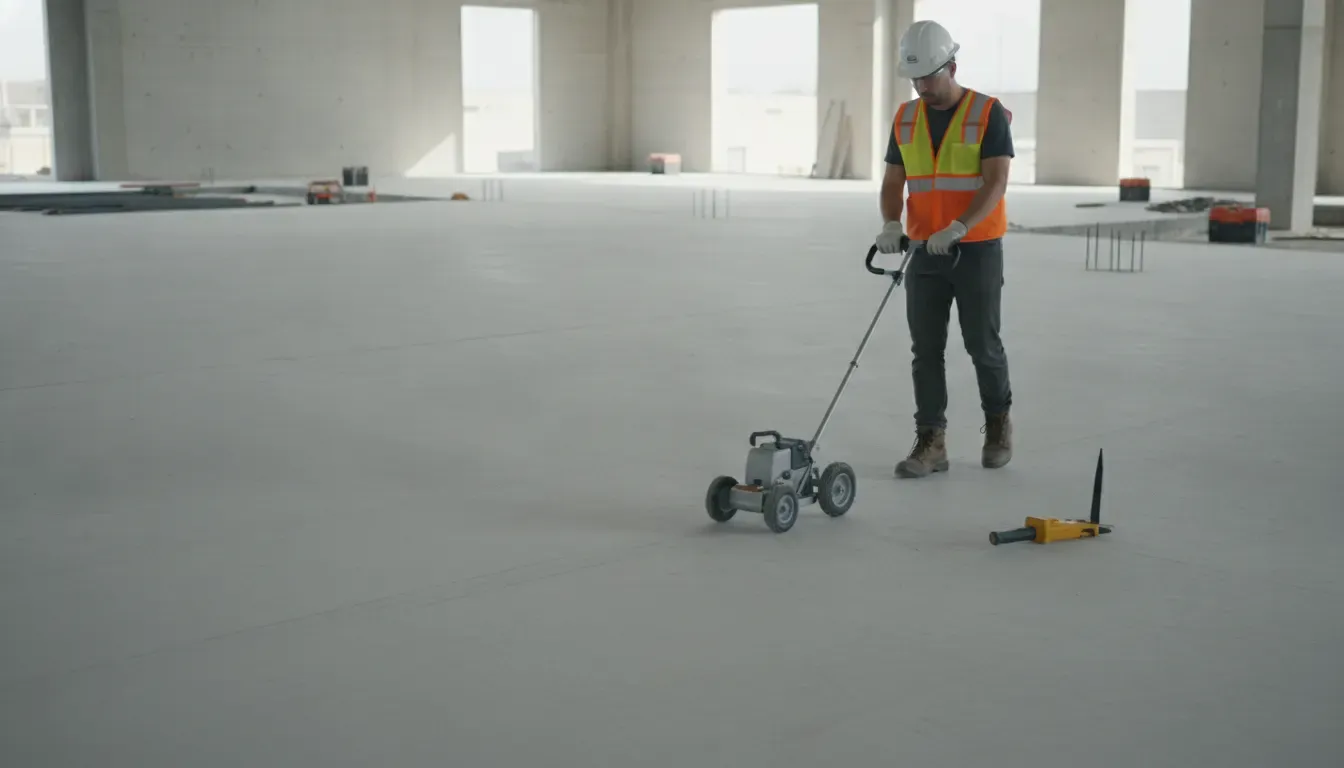
Ground penetrating radar (GPR) uses high-frequency electromagnetic pulses to investigate what is beneath a concrete surface without drilling, coring, or cutting. The system sends energy into the slab and records reflections from interfaces, embedded objects, and changes in material properties. Rebar, a conduit, a void, or a boundary between materials can return part of that energy to the antenna, creating patterns that a trained operator can analyze.
From pulses to an interpretable scan
GPR does not produce a simple photograph of the inside of a slab. As the equipment moves across the surface, it collects a series of reflections. Those signals are processed into scan data, images, or maps that help show the position and apparent geometry of subsurface features. The strength and timing of a reflection depend on the contrast between materials, as well as the concrete's conductivity and dielectric properties.
That interpretation matters. A scan may show a reflector or an unusual response, but the result still needs to be considered in context. Concrete composition, moisture, surface conditions, target size and orientation, reinforcement congestion, antenna selection, access, and depth can all affect visibility. GPR is a rapid, nondestructive testing method, but it is best used as part of an informed investigation rather than treated as a complete answer to every question. The GPR investigation services team can help translate field data into practical information for a planned project.
Why nondestructive scanning helps
Because the scan can be performed before the surface is disturbed, it can support safer decisions before drilling, coring, cutting, or demolition. Depending on the application and site conditions, GPR may help locate embedded reinforcement, cables, conduits, or anomalies and may support estimates of concrete cover or thickness. It can also contribute to condition assessments by indicating areas that warrant closer review. The result is useful planning information without creating new openings in the structure simply to look for a target.
GPR and EM locating serve different purposes
GPR and electromagnetic (EM) locating are complementary technologies, not interchangeable names for the same process. GPR can support detection of both metallic and non-metallic features by interpreting reflections from subsurface interfaces. EM locating is particularly useful for tracing conductive lines, such as metallic utilities or conductors that can carry an applied signal. A dual-technology approach can provide a broader picture, but neither method guarantees identification of every feature in every concrete environment. Qualified field review and project-specific interpretation remain essential when the consequences of a missed target are serious.
What Can GPR Detect in Concrete? Rebar, Cover, and Reinforcement
Before drilling, coring, cutting, or fastening into a slab, it helps to understand how reinforcement is arranged below the surface. Ground penetrating radar (GPR) can help locate reinforcing steel, estimate concrete cover, and show patterns in the reinforcement layout without opening the slab. The result is a subsurface view that supports safer, better-informed decisions, not a guarantee that every feature will be visible.
Rebar location and reinforcement layout
Rebar creates a strong reflection in GPR data because it differs from the surrounding concrete. By collecting scan lines across the work area. A qualified technician can interpret the position and spacing of reinforcing bars and identify areas where steel is likely to cross a planned penetration. GPR may also help show the direction of reinforcement and the broader layout of a mat or grid.
The Federal Highway Administration identifies measuring concrete cover and mapping rebar configuration as established GPR applications. It also describes GPR as a tool for determining structural reinforcement layout and estimating reinforcement cover. These findings are useful for planning, but the scan should be interpreted in the context of the structure, drawings, access, and the proposed work area. FHWA guidance on GPR and reinforcement provides additional technical context.
- Rebar position: A scan can indicate where reinforcing bars are located beneath the surface.
- Bar pattern: Multiple scan lines may help establish the direction, spacing, and configuration of reinforcement.
- Concrete cover: GPR can support an estimate of the distance between the surface and reinforcing steel.
- Pre-drilling decisions: Marked scan results can help a project team adjust a penetration location or choose a safer drilling approach.
What the scan means for your project
Rebar is not the only consideration before a concrete penetration. Dense reinforcement, moisture, surface conditions, target size and orientation, antenna frequency, and access can affect how clearly features appear. A scan may identify a likely bar or reinforcement zone, but it does not replace engineering judgment or confirm the structural consequences of cutting or drilling.
For that reason, concrete scanning works best as part of a documented planning process. Field markings, photos, scan data, and clear notes can give the contractor or facility team a shared reference before work begins. SafeLine combines GPR with electromagnetic locating when conductive lines may also be present, using each method for the conditions it addresses. Learn more about GPR and concrete scanning services and how a site-specific assessment can support the next step.
Post-Tension Cables, Conduits, and Other Embedded Objects
Concrete is rarely a blank, uniform mass. It may contain post-tension cables, electrical conduits, communication pathways, reinforcing steel, sleeves, anchors, or other elements installed during construction. Before drilling, coring, cutting, or demolition. A scan can help show where these features may be located so the planned work can be reviewed against the available subsurface information.
GPR sends electromagnetic pulses into the concrete and records reflections from interfaces and objects with different electrical properties. The resulting data can support mapping of embedded cables, conduits, and other objects. Because GPR can respond to both metallic and non-metallic features, it can add information where a visual review or construction drawing is incomplete. The Federal Highway Administration identifies mapping cables, conduits, and other embedded objects as a concrete GPR application: FHWA concrete GPR guidance.
| Common target | What a scan may show | Field caveat |
|---|---|---|
| Post-tension cables | Linear response patterns that may help indicate cable alignment and support a safer work-area review. | Interpretation depends on depth, orientation, congestion, surface access, and the quality of available data. Confirm the planned work with qualified personnel. |
| Metallic conduits and reinforcing steel | Reflective responses that may help map alignment, spacing, and the reinforcement or conduit layout. | Closely spaced metal can create overlapping responses, making individual features harder to distinguish. |
| Non-metallic conduits, sleeves, or other embedded objects | Changes in the surrounding material that may indicate an object or interface within the slab. | Material properties, moisture, size, orientation, and contrast affect visibility. A response is not automatically a positive identification. |
The purpose is not to treat a scan as a substitute for engineering records, as-built documentation, or informed field judgment. GPR is a nondestructive investigation method and a complementary tool, not a guarantee that every embedded feature will be visible or identified. Concrete composition, moisture, reinforcement congestion, antenna selection, surface conditions, access, and target orientation can all affect the result.
For contractors planning penetrations or removals, combining scan data with drawings, proposed work locations, field markings, photos, and a documented review creates a more useful decision record. SafeLine provides subsurface intelligence for contractors to help teams evaluate concrete work before equipment reaches the slab.
Voids, Delamination, Thickness, and Other Concrete Anomalies
GPR can reveal changes in concrete that may point to deterioration, separation, or inconsistent placement. Those findings are valuable before repair, coring, cutting, or demolition, but they should be treated as scan indications rather than a final diagnosis. The signal reflects changes in electrical properties and interfaces inside the slab. A qualified review is needed to determine what the pattern means for the specific structure.
For example, a scan may help identify areas associated with potential delamination or corrosion-related deterioration. Delamination is a separation between concrete layers or between concrete and reinforcement, while deterioration can have several causes. GPR can map areas with a higher likelihood of these conditions, but it does not replace engineering evaluation, targeted opening, or other testing when the project requires confirmation. The Federal Highway Administration lists deterioration and delamination assessment among GPR applications: FHWA guidance on GPR and concrete reinforcement.
Common anomaly indications
- Voids: open spaces or air-filled gaps that create a detectable contrast beneath the surface.
- Honeycombing: localized areas of inadequate consolidation that may contain irregular air spaces and aggregate patterns.
- Rock pockets: zones where coarse aggregate is concentrated or the concrete is not uniform.
- Thickness changes: variations in slab, deck, overlay, or cover thickness that may affect repair or drilling decisions.
- Debonding and deterioration: patterns that suggest separation or changed material conditions and may warrant closer review.
FHWA identifies heterogeneity such as rock pockets, honeycombing, and voids as potential GPR findings, and describes estimating deck, overlay, and reinforcement-cover thickness as an application. These capabilities do not mean every anomaly will be visible. Reinforcement congestion, moisture, concrete composition, target size, scan access, and antenna selection can all affect the result.
Results are strongest when the scan is interpreted in context with drawings, surface observations, construction history, and the intended work. A scan can identify where additional investigation may be appropriate, helping a project team focus follow-up testing instead of assuming the entire slab has the same condition. It should not be used to guarantee structural soundness or to authorize intrusive work without the responsible professional's review.
What GPR Cannot Reliably Tell You
GPR produces reflections from changes in the electrical properties of concrete and the materials or conditions below its surface. Those reflections can help an experienced technician identify patterns, but they are not a perfect inventory of everything inside a slab. The answer to what can gpr detect in concrete depends on the structure, equipment, scan conditions, and interpretation.
Concrete and site conditions affect visibility
Concrete composition matters because conductivity and dielectric properties affect how radar energy travels, reflects, and diminishes. Moisture can change those properties and may create useful contrast in some defects, while also complicating interpretation. Reinforcement congestion can produce overlapping or obscured responses, particularly where several targets are close together.
Target characteristics matter as well. A small feature, an object aligned unfavorably to the scan path. Or a target at greater depth may produce a weaker or less distinct response than a larger, better-oriented feature. Surface conditions can also affect the survey. A rough, uneven, coated, wet, or obstructed surface may limit antenna contact, scan coverage, or data quality. Access is part of the technical question: a scan cannot reliably evaluate areas that cannot be reached or covered from a suitable direction.
Equipment selection changes the result
There is no single frequency that is best for every concrete scan. Antenna selection involves a tradeoff between resolution and penetration, and the appropriate choice depends on the concrete, target, access, and purpose of the work. Ground-coupled systems must remain in contact with the surface, while air-coupled systems can survey without contact. These approaches are not interchangeable in every setting, and a faster screening scan may indicate where more detailed testing is warranted rather than answer every project question.
GPR also does not automatically identify a material, certify its structural condition, or establish a safe drilling location by itself. A reflection may indicate a rebar, conduit, void, interface, or another anomaly, but the signal requires context and qualified interpretation. GPR is best treated as a complementary engineering and damage-prevention tool, not a stand-alone answer to every subsurface problem. The Federal Highway Administration describes it in that way as well: GPR is a complementary tool, not a complete solution for every application.
Before drilling, coring, cutting, or demolition, have the scan reviewed in the field by a qualified professional. The review should account for scan coverage, concrete conditions, target geometry, surface access, and the intended intrusive work. GPR may be paired with electromagnetic locating when conductive lines are part of the concern, since each method provides different information. For common questions about scope and interpretation, see SafeLine's GPR and concrete scanning FAQs.
Choosing a GPR Frequency for Concrete Thickness and Detail
There is no universal "best" GPR frequency for every concrete scan. The right selection depends on the thickness and composition of the concrete. The size and depth of the target, the level of detail needed, and the conditions at the surface. In practical terms, frequency selection balances resolution against penetration. Higher frequencies can provide more detailed information over a shallower range, while lower frequencies may support greater penetration with less fine detail. The tradeoff must be evaluated against the actual scanning objective.
GPR sends electromagnetic pulses into the concrete and records reflections from interfaces, embedded objects, and changes in material properties. A strong or useful response depends on the contrast between materials, not simply on whether an object is present. Conductivity, moisture, reinforcement congestion, surface access, target orientation, and the concrete's dielectric properties can all affect what the data shows.
FHWA describes concrete GPR systems as operating across a broad range, including approximately 100 to 5,000 MHz for concrete pavement applications. This illustrates why equipment selection is a project decision rather than a fixed setting. FHWA's concrete GPR guidance also emphasizes that the collected data must be processed and interpreted to create a condition map or subsurface image.
What determines the frequency choice?
A scan focused on shallow reinforcement, concrete cover, or closely spaced features may call for a different antenna than an investigation seeking information deeper in a thick slab. The goal is not to select the highest number on an equipment label. It is to obtain data that is useful for the decision at hand, such as planning a core, evaluating a proposed cut, or investigating an anomaly.
- Target detail: closely spaced or smaller features may require greater resolution.
- Concrete thickness and access: slab geometry and the available scanning surface influence practical penetration.
- Site conditions: moisture, conductivity, surface condition, and reinforcement congestion can limit visibility.
SafeLine's equipment references include example configurations such as 400 MHz, 350 MHz, dual-frequency 300/800 MHz, and 350 HS antennas. These are examples of available equipment configurations, not a promise that every antenna is used on every job. The field team selects an appropriate approach after considering the structure, access, target, and requested deliverable.
GPR also should not be treated as a replacement for every locating method. Electromagnetic (EM) locating is complementary and can be especially useful for conductive lines. A combined GPR and EM approach may provide broader information than relying on one technology alone. Both methods still require qualified interpretation and verification before drilling, coring, cutting, or demolition.
Frequently Asked Questions
Can GPR find post-tension cables before drilling?
GPR can help locate post-tension cables and other embedded objects before drilling, coring, or cutting. Results depend on target depth, size, orientation, concrete conditions, reinforcement congestion, surface access, and scan interpretation. Treat the scan as a risk-reduction tool, not a guarantee that every cable or obstruction will be identified.
Can GPR detect voids or honeycombing in concrete?
It can indicate areas consistent with voids, honeycombing, rock pockets, debonding, or other changes in the concrete. Air pockets and moisture can create detectable contrasts beneath the surface. Because similar reflections can have more than one explanation, a qualified review and appropriate follow-up testing may be needed before making a repair or structural decision.
Does GPR detect every pipe or conduit inside concrete?
No. GPR may detect metallic and non-metallic conduits when their properties, size, depth, and surrounding conditions produce a useful reflection. Conductive lines may also benefit from electromagnetic locating, which complements GPR. Neither method should be treated as a universal identification system, especially where access is limited or reinforcement is dense.
How deep can GPR see in concrete?
There is no single guaranteed depth for every slab or wall. Penetration and detail change with antenna frequency, moisture, material properties, target size, reinforcement, and surface conditions. Lower frequencies may provide more penetration while higher frequencies can provide finer detail, so the appropriate setup is selected for the site and objective. FHWA describes GPR as a complementary tool rather than a complete stand-alone solution: FHWA guidance.
Ready to Plan a Safer Concrete Investigation?
GPR can help identify embedded reinforcement, cables, conduits, voids, and other subsurface features, but results depend on site conditions and careful interpretation. A site-specific assessment can help your team make more informed decisions before drilling, coring, cutting, or demolition. To discuss your project and provide the right details, contact SafeLine through the website form.