
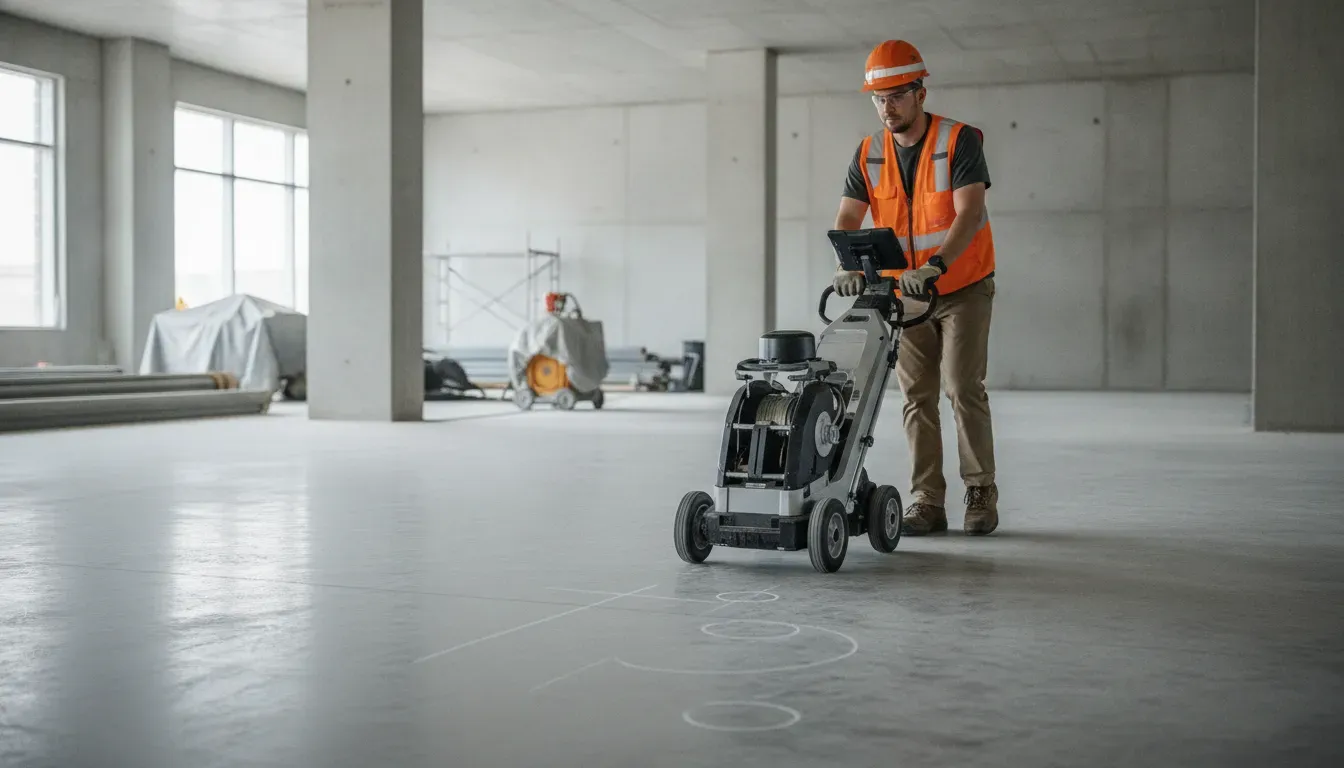
Concrete can look solid and empty while hiding reinforcement, electrical conduit, post-tension cables, radiant heating, or other embedded hazards. That is why concrete scanning before drilling or cutting should be treated as a required project step, not an optional visual check. A scan gives the crew better information before a bit, core drill, saw, or anchor enters the slab.
Planning work on a concrete slab or wall? Request a concrete scanning quote from SafeLine before drilling or cutting begins.
This article focuses on the practical decision contractors, facility teams, and project managers need to make before creating a penetration. For a broader explanation of methods, applications, and deliverables, see SafeLine's GPR and concrete scanning guide.
What Is Concrete Scanning and How Does It Work?
Concrete scanning is a non-destructive investigation used to identify and mark objects inside or below a concrete member before the member is drilled, cored, saw-cut, or otherwise penetrated. The technician scans the defined work area, interprets the data, and marks relevant findings on the surface so the project team can compare the proposed work location with the detected objects.
Ground penetrating radar, or GPR, is commonly used because it can help locate both metallic and non-metallic features. The radar signal enters the concrete and produces reflections when it encounters changes in material or structure. A trained operator interprets those reflections in the context of the slab, wall, scan direction, surface condition, and available drawings.
Electromagnetic, or EM, locating may also be relevant around the work area when the project includes conductive utilities or lines that enter the building or cross the surrounding site. EM and GPR do different jobs. EM can trace a conductive path when the signal can be applied or detected, while GPR can help identify non-metallic objects and embedded features. Using the right combination supports a more complete subsurface investigation.
A scan is not a guarantee that every feature will be visible under every condition. Concrete thickness, reinforcement density, moisture, surface access, signal interference, object orientation, and the quality of available records all affect interpretation. The result is useful project information, but it still needs to be applied with the engineer's design, the contractor's work plan, and the site's safety procedures.
What Hazards Are Hidden Inside Concrete Slabs and Walls?
The most important reason to scan before drilling or cutting is that the surface rarely tells the full story. A clear-looking area may contain several different materials at different depths.
Rebar and welded wire reinforcement
Reinforcing steel helps a slab or wall carry loads. Cutting through it may weaken the member, damage the intended reinforcement layout, or create a structural issue that is not obvious until after the work is complete. A scan can help the team plan a location that avoids detected reinforcement when the design permits an alternate position.
Post-tension cables
Post-tensioned concrete requires special caution. A cable may be under tension, and striking one during drilling or cutting can create a serious safety and structural hazard. Drawings and surface clues are valuable starting points, but they may be incomplete, outdated, or difficult to match to field conditions. GPR scanning can help locate likely cable paths and other embedded features before a penetration is made. When cable locations remain uncertain, the work should stop until the responsible project professionals determine a safe path forward.
Electrical conduit and communications pathways
Electrical conduit, data conduit, and other pathways may be cast into slabs, walls, decks, and columns. Drilling into a conduit can damage the system, expose workers to energized conductors, interrupt operations, and create an expensive repair. The risk is higher in remodels and occupied facilities where as-built records may not reflect later changes.
Plumbing, radiant heat, and other embedded systems
Some slabs contain plumbing, hydronic or radiant heating, sleeves, anchors, or process lines. A damaged line can release water or another material into a finished space, interrupt a facility, and expand a small penetration into a major repair. The project team should identify the expected systems and communicate them to the scanning technician before the visit.
Voids, thickened areas, and unexpected anomalies
Scanning may also reveal conditions that change the work plan, such as voids, changes in slab thickness, repairs, or other anomalies. Not every reflection has the same meaning, and GPR does not measure every object in the same way. The value is in identifying evidence that deserves a closer review before the crew commits to a location.
When Is Concrete Scanning Required by Code or Contract?
There is not one universal rule that uses the same words to require a scan before every hole in every type of concrete. Requirements may come from the project specifications, owner standards, engineer of record, general contractor's safety program, facility procedures, insurer expectations, or a method statement prepared for the work. Some projects also require documented scanning as part of their quality or damage-prevention process.
That distinction matters. A crew should not interpret the absence of a single nationwide sentence saying "scan every slab" as permission to drill without investigating the work area. The responsible question is whether the team has enough reliable information to avoid hidden hazards and protect the structure, workers, building systems, and schedule.
For drilling, coring, or sawing work, scanning is especially important when:
- The proposed penetration is in a post-tensioned or otherwise engineered structural member.
- Drawings are missing, incomplete, or inconsistent with field conditions.
- The work is in an older building, a renovation, or an occupied facility.
- The slab or wall may contain electrical, communications, plumbing, or heating systems.
- The project has a defined scanning, coring, or permit requirement.
- A missed penetration would create a serious safety, schedule, operational, or financial consequence.
The Concrete Sawing and Drilling Association's best-practice guidance for operating in GPR-scanned slabs also emphasizes coordinating the planned holes, openings, trenches, and saw cuts with the scanning process. The scan is most useful when the technician knows the actual work locations and the crew follows the resulting markings and project controls.
What Happens If You Drill or Cut Without Scanning?
Skipping the scan can turn a short installation task into a safety incident, repair, or project delay. The possible consequences depend on what is hidden and how the work is performed, but common risks include:
- Striking a cable or conduit: The crew may damage an electrical or communications system, interrupt service, or expose workers to an energized system.
- Damaging a post-tension cable: A damaged cable can create a serious hazard and may require structural assessment and repair.
- Cutting reinforcement: Removing or weakening reinforcement can affect the member's intended performance.
- Causing a water release: A punctured plumbing or heating line can damage finishes, equipment, inventory, and occupied areas.
- Creating rework: A misplaced or abandoned hole can require patching, relocation, redesign, or a second mobilization.
- Stopping the schedule: Investigations, incident response, repairs, and approvals can delay following trades and inspections.
These risks are not eliminated by relying on memory, a quick visual inspection, or a drawing alone. Records should be reviewed, but the field condition should be checked before the final location is selected.
What Should a Pre-Drilling Concrete Scan Include?
A useful scan starts before the technician arrives. The project team should identify the proposed work and share enough context for the scanning plan to match the decision the crew needs to make.
1. Define the work area and proposed penetrations
Mark or document the exact locations for holes, cores, anchors, sleeves, trenches, or saw cuts. Include dimensions, depth, diameter, direction, and any acceptable alternate locations when those details are known. A scan of the general room is not the same as a scan designed around a specific drilling layout.
2. Gather drawings and construction records
Provide structural drawings, electrical or mechanical plans, post-tension information, previous scan results, renovation records, and photos when available. These materials do not replace field scanning, but they help the technician interpret the data and identify areas that deserve attention.
3. Confirm access and site conditions
Clear the scan area of movable items, confirm whether one or both sides are accessible, and identify floor coverings, standing water, uneven surfaces, active equipment, or restricted areas. Note whether the project is in a slab-on-grade, suspended slab, wall, deck, column, or another structural condition.
4. Scan with the method that fits the question
GPR is often used for embedded concrete features, while EM locating may help trace conductive utilities around or beyond the concrete. The selected method depends on the material, access, expected targets, and project objective. A professional should explain limitations rather than treating one instrument as a universal answer.
5. Mark findings and coordinate the go or no-go decision
The scanning technician should communicate detected features, proposed clearances, uncertainty, and areas that could not be interpreted confidently. The drilling or cutting crew must understand the marks and any required offsets before work begins. If the planned location intersects a detected feature, move the location when the design allows or obtain the required technical decision before proceeding.
Have a marked drilling area and a deadline? Send the project details through SafeLine's contact form so the scan can be scoped to the work.
What Can a Concrete Scan Confirm, and What Can It Not Confirm?
A scan can provide evidence about the location of detectable or interpretable features in the defined area. It can help the team choose between proposed penetration points, identify likely reinforcement or cable paths, and document field markings for coordination.
A scan does not automatically confirm that a location is structurally approved, that a hole is safe at every depth, or that no undetectable feature exists. GPR has technical limits. Dense reinforcement, signal attenuation, surface conditions, object orientation, and access can affect the data. Depth readings are estimates and should not be treated as a substitute for project-specific engineering or physical verification when the work requires a higher level of certainty.
This is why scanning should be one part of a controlled process. Review the plans, scan the defined work area, mark the findings, follow the project's clearance and permit requirements, and stop when the evidence does not support the planned work. The safest scan is not the one that produces the most marks. It is the one that helps the project make a documented decision before the tool enters the concrete.
How to Schedule a Scan Before Drilling or Cutting
When requesting a scan, include the information that changes the method and scope:
- Project location and the type of concrete member involved.
- Number, size, depth, and purpose of the planned penetrations or cuts.
- Proposed work dates, site access restrictions, and whether the facility is occupied.
- Available structural, post-tension, mechanical, electrical, and renovation drawings.
- Known concerns, previous repairs, prior scans, or suspected utilities.
- Required deliverables, such as surface markings, photos, field notes, or a written report.
Clear scope helps the provider plan the right equipment and helps the project team receive information it can use. SafeLine provides GPR and concrete scanning support for contractors, engineers, facility teams, and property owners across Virginia, Maryland, Washington, D.C., and North Carolina. Review the GPR and concrete scanning service page to understand the service fit, then share the work details through the contact form.
Do not guess at what is inside the slab. Contact SafeLine to plan a GPR concrete scan before drilling or cutting.
Frequently Asked Questions About Pre-Drilling Concrete Scans
Do I need to scan concrete before drilling?
In most project settings, scanning is the responsible starting point before drilling, coring, anchoring, or cutting because the surface does not show every embedded hazard. The project specifications, engineer, owner, and safety program may also make scanning a formal requirement. Confirm the applicable requirements for the specific structure and work.
Can GPR find everything inside concrete?
No. GPR can help identify many embedded features, but results depend on concrete condition, depth, reinforcement, access, object orientation, and other site factors. A qualified operator should explain the scan's limits and identify areas that remain uncertain.
Is concrete scanning the same as utility locating?
No. Concrete scanning focuses on embedded features in a slab, wall, deck, or other concrete member. Utility locating focuses on buried lines in soil and around a site. The methods can overlap when conductive utilities enter a structure or when a project requires both concrete and underground investigation.
Should I scan before a core drill or a saw cut?
Yes. Both core drilling and saw cutting can intersect reinforcement, post-tension cables, conduits, or other systems. The proposed hole or cut line should be identified before the scan so the technician can evaluate the actual work area and mark findings for the crew.
What should I do if the scan shows a cable or conduit in the planned location?
Stop and communicate the finding to the responsible project professional. Move the location only when the design permits it, or obtain the required engineering, owner, or contractor decision. Do not treat a clearance question as a field improvisation.