
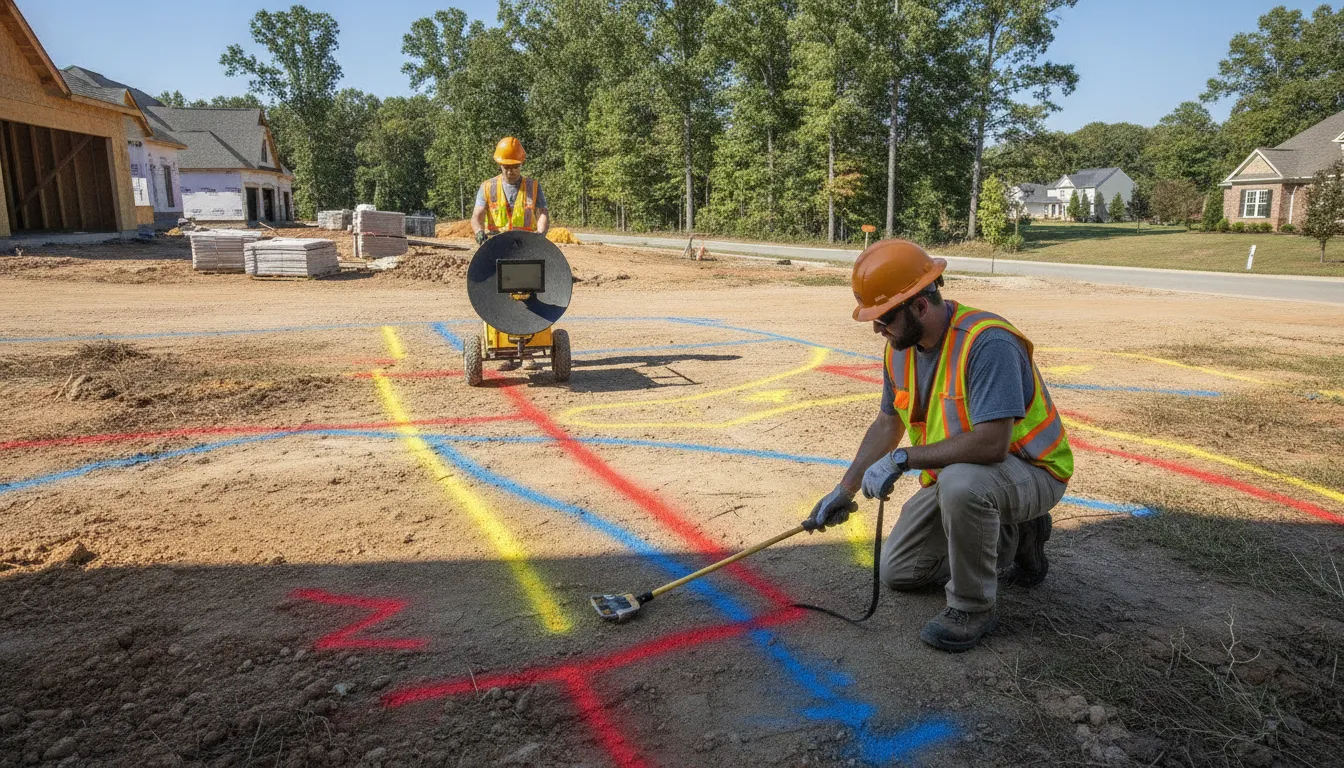
Before a fence, pool, addition, trench, or facility improvement moves from plan to excavation, know which buried lines a public 811 request covers.
Private lines can include irrigation, landscape lighting, pool equipment feeds, and other infrastructure that may not be marked through that process.
Contact SafeLine Subsurface through the project form to discuss the work area and locating needs.
Utility locating fairfax county va helps homeowners, contractors, and project teams identify privately owned underground infrastructure before digging. SafeLine uses complementary electromagnetic (EM) locating and ground penetrating radar (GPR) methods. The best approach depends on site conditions and project scope. Private locating supports, rather than replaces, the applicable 811 process.
For broader background on the service and how private locating fits into excavation planning, see private utility locating in Virginia. The next step is understanding what a private locate covers and how it works alongside public utility marks.
Private Utility Locating Services in Fairfax County
Before a fence, pool, landscape project, addition, trench, or other excavation begins in Fairfax County, understand what the public utility marks cover and what they may leave out.
Virginia's 811 process addresses utility-owned lines in the requested work area. Privately owned lines such as irrigation, power to an outbuilding, and some private water or sewer connections may require a separate investigation.
811 and private locating are complementary, not interchangeable. You should follow the applicable call-before-you-dig process, review the response status, and then arrange private locating for infrastructure that may not be marked through the public request. The Virginia State Corporation Commission states that excavators must review and heed the positive response marking status before beginning excavation or demolition. Its guidance also identifies a positive response status for situations where a known private utility requires the private utility owner to be contacted for a locate. Read the Virginia SCC positive response guidance.
A private locate can help property owners and project teams investigate the specific area where work is planned. SafeLine uses electromagnetic locating equipment for conductive lines and ground-penetrating radar as complementary methods for subsurface detection. Depending on the project scope, the work may involve field markings, documentation, verification photos, or mapping. These details should be confirmed for the individual assignment rather than assumed.
SafeLine lists Virginia among its service states, but county-level availability and timing should be confirmed for your Fairfax County project. For more detail on how the two services fit together, review private locating beyond 811 marks.
Services We Provide in Fairfax County
Utility locating in Fairfax County, VA can support different projects. A homeowner may be planning a fence or pool, while a contractor may be preparing for trenching or facility expansion.
SafeLine scopes the work around the site, the planned excavation, and the information the project team needs. Residential locating may include buried electric, gas, water, sewer, communication lines, irrigation, and storm drains. Commercial work can support construction sites, site work, additions, development, and facility expansions.
For homeowners, the goal is to identify private lines that may not be included in public utility marks before digging changes the property. Common planning situations include landscaping, drainage work, patios, decks, pools, fencing, and additions. The private locating for homeowners page explains how this work complements, rather than replaces, an 811 request.
For contractors and project teams, locating can help clarify subsurface conditions before layout, excavation, boring, or other site work. SafeLine's subsurface intelligence for contractors supports a scope-led approach for construction companies, developers, general contractors, and facility teams. The exact area investigated and the resulting records depend on project requirements.
| Project type. | Planning focus. | Possible support. |
|---|---|---|
| Residential work | Private lines near a fence, pool, deck, landscape project, or addition. | Scope the work area and discuss suitable locating methods. |
| Commercial site work | Utilities that may affect excavation, trenching, boring, or layout. | Support planning with locating and scope-dependent records. |
| Facility expansion | Subsurface conditions around buildings and planned improvements. | Identify information gaps before work proceeds. |
SafeLine uses Ground Penetrating Radar (GPR) and electromagnetic (EM) locating equipment as complementary methods. EM locating can help trace conductive lines when suitable signal conditions exist. GPR can support subsurface detection where the site and material conditions make that method useful. Neither method should be treated as a universal guarantee, so the investigation plan should account for site conditions, access, utility construction, and the limits of available records.
Depending on the agreed scope, project materials may include field markings, documentation, verification photos, or utility mapping. These are not automatic deliverables for every locate. If your Fairfax County project needs a map, report, or other record, identify that requirement when requesting a scope. SafeLine's utility investigation process and deliverables provides additional context on how project needs, field methods, findings, and limitations are connected.
Why Fairfax County Contractors Trust SafeLine Subsurface
Contractors need more than a mark on the ground. They need a clear understanding of what was requested, which areas were investigated, and what the findings mean for the next phase of work. SafeLine starts with project scope, so the locating effort can reflect the planned excavation. Site work, addition, development, or facility expansion rather than relying on a vague work-area description.
SafeLine also uses electromagnetic (EM) locating and ground-penetrating radar (GPR) as complementary methods. EM locating can help trace conductive lines, while GPR supports subsurface detection where conditions and site factors allow. Using the methods together gives the field investigation a broader technical basis without suggesting that any locating method can guarantee detection of every underground feature.
Communication is part of that process. A contractor can provide the work limits, planned activities, available site information, and questions that matter to the crew. SafeLine can then clarify the proposed scope and confirm which findings, markings, photos, mapping, or other documentation are appropriate for that specific project. Those deliverables should be confirmed in advance, not assumed.
For a broader overview of methods and project planning, see SafeLine's private utility locating in Virginia. Contractors seeking subsurface intelligence for contractors can use the same scope-first approach when requesting project-specific availability in Fairfax County.
Coverage Areas Within Fairfax County
SafeLine lists Virginia and a broader Mid-Atlantic service region that includes Maryland, Washington, D.C., and North Carolina. That regional footprint provides useful context for projects involving multiple locations, but it does not replace a project-specific availability check.
For utility locating in Fairfax County, VA, confirm the service area, site conditions, work limits, and scheduling requirements when you submit your project details. Access, surface conditions, utility records, and the type of locating requested can affect how a project is scoped. SafeLine does not publish an unsupported neighborhood list or promise a particular response time for every Fairfax County request.
Review SafeLine's Northern Virginia coverage, then use the contact form to describe the property and planned work. A clear scope helps the team determine whether the request fits the available service area and what field work or documentation may be appropriate.
How Do You Schedule Utility Locating in Fairfax County, VA?
Good scheduling starts with a clear picture of the work area. Public 811 notification and private locating serve complementary purposes, so share both the project plan and any information you received from Virginia's notification system.
- Define the limits of the work. Describe the full excavation or demolition area, not just the point where digging begins. Virginia rules allow GPS coordinates to identify a point, line, multi-segment line, or polygon, but a point or line should include a measured distance defining the work area. For trenching or boring, identify the proposed center line and excavation width. See the Virginia excavation-limit requirements.
- Explain the planned work. Tell the locating team whether the project involves a fence, pool, landscaping, addition, trench, bore, site-work package, or facility expansion. Include the expected dig areas, access limitations, and any phases that may affect the scope.
- Share site details. Provide the property address, a site plan or marked-up image when available, known structures, access instructions, and visible utility features. White lining can help delineate where excavation will take place.
- Provide existing 811 information. Share the ticket details, positive-response status, and public marks already on site. Virginia marking standards describe marks as approximate horizontal locations and call for APWA color codes, so do not treat them as a substitute for planning or private locating. Review the Virginia marking standards before excavation.
- Request a project-specific scope. Use SafeLine's contact form to describe the site and planned work. Scope, pricing, and any potential markings, documentation, photos, or mapping should be confirmed for the individual project.
What Should Fairfax County Project Teams Prepare Before Digging?
Good preparation gives a locate request enough detail to produce useful information in the field. Before work begins, homeowners, contractors, and facility teams should define exactly where digging will occur, what work is planned, and which privately owned utilities may be present. That preparation also helps separate the public 811 process from a private investigation, so neither is treated as a substitute for the other.
Define the work limits
Start with a clear drawing, site plan, or marked-up aerial image showing the proposed excavation area. Include the limits of a fence, pool, addition, drainage run, trench, bore, landscaping project, or other planned work. Virginia rules require a locate request to describe the proposed excavation or demolition limits with enough detail for operators to identify the work location. Depending on the project, those limits may be described with GPS coordinates, a line, or a polygon. A single point or line should also include the measured area around it that will be disturbed. See the Virginia excavation-location requirements for the applicable wording.
For continuous work such as trenching or boring, show the intended center line and the planned width. White lining the work area can make the request easier to interpret and can reduce ambiguity when the field team arrives. If the plan changes, expand or revise the work limits before digging rather than assuming that marks outside the original area cover the new work.
Gather plans and known utility information
Collect current civil plans, as-built drawings, prior survey information, utility plans, and records of past improvements. Ask the property owner or facility manager about irrigation, landscape lighting, private electrical feeds, pool equipment, water or sewer laterals, storm drainage, communications lines, and other installations. Note service entrances, meters, transformers, wells, tanks, generators, and outbuildings. Records can be incomplete, so treat them as planning inputs rather than proof of an underground line's exact location.
For contractors and facility teams, identify the excavation method and the decisions the locate needs to support. A shallow landscape cut, a foundation addition, a directional bore, and a long utility trench can require different scope discussions. Explain whether the team needs field marks, targeted verification, mapping, photographs, or other documentation. These items can depend on the project and should be confirmed before the work is scheduled.
Confirm 811 status and plan private locating
Submit the applicable 811 request and record the ticket information, work limits, and positive response status. Virginia's rules state that an excavator should review and heed the positive response marking status before beginning excavation. The Virginia SCC explains that the system communicates marking status between excavators and utility operators through its Positive Response System.
Then ask which lines may be privately owned or outside the public utility mark-out. Virginia guidance notes that property owners are responsible for locating private underground lines or arranging for that work. A private locate can be scoped around the specific property and project, using electromagnetic locating alongside GPR when appropriate. For a clearer explanation of the two roles, review private locating beyond 811 marks.
Coordinate access and site conditions
Before the field visit, confirm the address, access route, gate or lock information, work hours, parking constraints, and a site contact who can answer questions. Identify areas that are fenced, overgrown, occupied, wet, paved, or otherwise difficult to access. Keep the proposed work area visible and safe for inspection. Finally, list unresolved scope questions in the contact form. This helps the locating team determine what information is needed for the Fairfax County project and confirm availability for the requested site.
Frequently Asked Questions
Do I still need to contact 811 if I hire a private utility locator?
Yes. Public 811 and private locating address different parts of a project. Contact 811 for public utility marking, then arrange private locating for privately owned lines that may not be included. Virginia requires excavators to review and heed the positive response status before excavation or demolition begins (Virginia SCC guidance).
What private utilities may need to be located on my property?
Depending on the site, private lines can include irrigation, power to a detached garage or other outbuilding. Landscape lighting, pool equipment, private water or sewer laterals, communications, and storm drainage. The relevant lines depend on the property's improvements and the planned work area.
What methods are used to find underground utilities?
A locating plan may combine electromagnetic locating for conductive lines with ground penetrating radar for subsurface detection. These methods provide complementary information, and the appropriate approach depends on the site, utility materials, access, and project scope.
What should I provide when requesting a locate?
Share the project address, planned excavation area, work type, and any available site plans or utility information. Clearly defined limits help the locating team focus the investigation. Virginia rules allow a work area to be described with GPS coordinates or white lining, and continuous trenching or boring should show the center line and width (Virginia administrative code).
Contact SafeLine Subsurface About Your Fairfax County Project
Clear project details help determine the right utility locating approach for your property, work area, and planned excavation. To confirm scope and request utility locating information, complete SafeLine Subsurface's contact form. Share the project location, planned work, and any known utility concerns so the team can review the request and discuss the next appropriate step.