
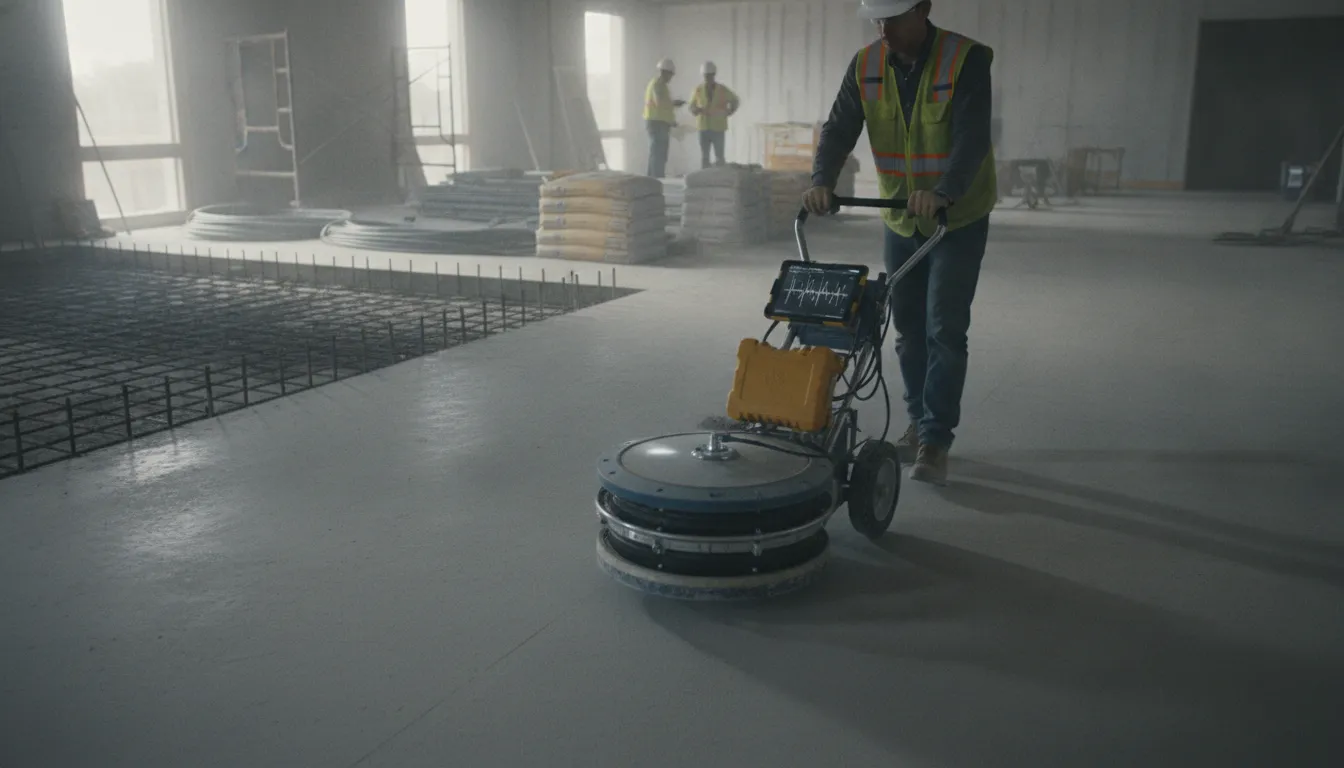
Before a crew drills, cores, cuts, or anchors concrete, the key question is not which technology sounds more advanced. It is which method fits the element, access, occupancy, target, and safety controls on the project.
For gpr scanning vs x-ray concrete, GPR is often the practical starting point. It is non-destructive, uses non-ionizing electromagnetic pulses, and generally needs access to only one side. X-ray can produce a clear radiographic image, but it typically requires access on both sides and controlled conditions. Neither method is universal. The right choice depends on the concrete and the work around it.
Both approaches can help identify embedded features such as rebar, post-tension cables, and conduit, but they gather that information in different ways. This GPR concrete scanning service guide starts with the mechanics of X-ray imaging, then compares the practical tradeoffs engineers and contractors need to evaluate.
How X-Ray Concrete Scanning Works
Concrete X-ray is a form of industrial radiography. An X-ray source sends ionizing radiation through the concrete element, while film or a digital detector sits on the opposite side. The resulting image is a shadow view of the materials inside, created because radiation is absorbed differently by materials with different densities. In practice, that means the method requires access to both faces of the slab, wall, or other element.
Radiography's main strength is image clarity. A clear structural image can help show the relationship between embedded features, and X-ray may be useful for thin, heavily congested elements when both sides are accessible. It can provide fine detail that may be more difficult to interpret through other methods. That advantage does not make it universally suitable, however. Thicker concrete or dense reinforcement can make the image harder to read and may require additional shots.
Safety controls are part of the method
Because X-ray uses ionizing radiation, the work requires more than positioning equipment and taking an image. Radiography generally requires a controlled exclusion zone, qualified or certified radiation personnel, and coordination to keep people outside the exposure area. The site may need to be cleared or restricted while the exposure occurs. The University of Toronto's industrial radiography safety guidance describes these controls and explains how ionizing radiation forms the inspection image.
Two-sided access is another practical limitation. If the rear face of a concrete element is against soil, occupied space, finishes, equipment, or another obstruction, placing the detector opposite the source may not be feasible. Film or plate processing can also mean the result is delivered after the exposure rather than marked immediately during the scan. For an occupied facility or active jobsite that cannot be evacuated, a non-ionizing method such as GPR may be preferred. The choice remains subject to site conditions and professional interpretation.
How GPR Scanning Works in Concrete
Ground penetrating radar, or GPR, sends high-frequency electromagnetic pulses into concrete. It measures signals that reflect back when they encounter changes in material. Rebar, post-tension cables, conduit, voids, plastic pipe, and changes in slab thickness can produce detectable responses because each affects the signal differently. This makes GPR useful before drilling, coring, cutting, or anchoring. The scan still requires qualified interpretation. It is not a promise that every target will be visible under every site condition.
From reflected signal to target depth
As the antenna moves across a floor, wall, ceiling, or column, the system records reflected signals along the scan path. The travel time of a reflection helps estimate how far below the surface a target sits. A technician then interprets the response in context, considering the concrete, target geometry, reinforcement pattern, moisture, and scan direction. The result is a working map of likely embedded features rather than a universal underground view.
That distinction matters on real projects. Varying slab thickness, moisture levels, dense reinforcement, surface finishes, and other field conditions can affect interpretation. Drawings can help, but they should not replace field investigation. For a broader technical introduction, see how GPR scanning works, including its capabilities and limitations.
Why the workflow is practical on active sites
GPR is non-destructive, uses low-power non-ionizing radio waves, and generally requires access to only one side of the concrete. That allows scanning on slab-on-grade floors, foundations, and walls where the opposite face may be inaccessible or backfilled. Findings can be marked on the surface in real time, giving a crew usable information before it commits to a core or cut. Nearby work may continue, subject to the site's safety plan and the technician's access requirements.
SafeLine combines GPR with concrete scanning, mapping, field markings, verification photos, and documentation. Its GPR capability can address metallic and non-metallic targets. Electromagnetic locating equipment is also used for conductive lines, but EM locating is a complementary method for utility investigation, not a substitute for concrete GPR. When a project needs a coordinated scan and documented field information, review the GPR concrete scanning service guide for the implementation details.
GPR does not produce the same kind of radiographic image as X-ray. Its value is the combination of non-destructive access, depth estimates, field interpretation, and immediate marking, with conclusions adjusted to the actual concrete and site conditions.
How GPR Scanning and X-Ray Compare for Concrete
Both methods can reveal embedded features before drilling, coring, cutting, or anchoring. They solve different site problems. GPR sends low-power, non-ionizing electromagnetic pulses into the concrete and interprets reflected signals. X-ray uses ionizing radiation from one side and a film or digital detector on the other. The practical choice depends on access, occupancy, concrete conditions, schedule, and the information the crew needs.
| Factor | GPR | X-ray |
|---|---|---|
| Physics | Reads reflections from changes inside the concrete. | Creates an image as radiation passes through materials of different densities. |
| Access | Usually requires access to one face of the element. | Requires the source and detector on opposite faces. |
| Radiation controls | Non-ionizing and generally does not require a radiation exclusion zone. | Requires controlled access, qualified radiography personnel, and site safety procedures. |
| Depth | Can provide interpreted depth information from reflected-signal travel time. | Produces a radiographic image, but does not provide the same direct depth readings for each target. |
| Workflow | Targets can be interpreted and marked in the field as scanning proceeds. | Film or plate processing is part of delivering the image. |
| Disruption | Often fits active or occupied sites with less interruption. | May require staging, an exclusion area, or an after-hours shutdown. |
| Best fit | One-sided access, slabs-on-grade, foundations, walls, and projects needing field markings. | Thin, congested, two-sided elements where a clear radiographic image is especially valuable. |
These distinctions are practical guidance, not a guarantee of identical results on every project. Moisture, thickness, reinforcement density, access, and operator interpretation affect both methods. X-ray can provide higher image resolution in heavily congested concrete. GPR is often more workable when the opposite face cannot be reached or the area cannot be cleared. For planning, review the concrete scanning cost factors that can change the scope, setup, and method recommendation.
When Is X-Ray the Better Choice?
X-ray is a legitimate specialized option when the concrete element is relatively thin. Both faces are accessible, and the project needs a clear radiographic image of a congested area. In that setting, radiography can show fine structural detail that may require more interpretation with GPR. It is not automatically the better method, but it can be useful when image clarity is the deciding requirement.
Thin, congested elements with two-sided access
Concrete X-ray passes ionizing radiation through the element to a film or digital detector on the opposite side. Because the radiation is absorbed differently according to material density, the resulting image can provide a direct visual representation of embedded features. That can help when reinforcing steel, conduit, or other elements are tightly grouped in a thin slab or wall and a film-style image is valuable.
The method depends on practical access. A qualified radiography team needs to position a source on one face and a detector on the other. If the rear face is blocked by soil, another structure, finished space, or permanent equipment, X-ray may not be feasible. Thicker concrete and heavy reinforcement can also make images harder to interpret and may require additional shots, adding time and staging requirements.
Safety controls are part of the method
Industrial radiography uses ionizing radiation, so it requires a controlled area, trained and appropriately certified operators, and a cleared exclusion zone. Occupants and nearby crews may need to leave the area during exposure. This can make X-ray difficult in hospitals, occupied facilities, active production areas, or projects with a tight work window. The University of Toronto's industrial radiography safety guidance identifies evacuation and exposure prevention as central planning considerations: review its radiography safety guidance.
When both sides are accessible and the site can support those controls, X-ray may complement GPR rather than replace it. The decision should account for element thickness, congestion, access, occupancy, schedule, and the type of information the crew needs before drilling or cutting. A method that produces a sharp image is only useful when it can be deployed safely and interpreted in the conditions present.
When Is GPR the Better Option?
GPR is often the more practical choice when the crew can reach only one face of the concrete or when the surrounding space must remain in use. A scan can be performed from the accessible surface of a slab, wall, foundation, ceiling, or column, rather than requiring a source and detector on opposite sides. That makes it useful for slabs-on-grade, foundation elements, and backfilled walls where the rear face is unavailable. It also avoids the access and staging demands associated with radiography.
GPR uses low-power, non-ionizing radio waves, so it does not create the radiation controls associated with X-ray work. This matters on active construction sites, occupied buildings, hospitals, facilities, and other locations where clearing an exclusion zone or stopping nearby operations would be difficult. GPR can generally be carried out with less disruption, allowing adjacent work to continue when the site plan and safety conditions permit it. The right method still depends on the element, target, access, and project requirements, not on a blanket rule.
Depth information and immediate field marking
During a GPR scan, the system records reflected-signal travel time and uses that information to estimate the depth of detected features. Depending on the material and conditions, the scan may help identify rebar, post-tension cables, conduit, voids, and other changes within the concrete. Findings can then be marked on the surface for planned drilling, coring, cutting, or anchoring. This direct field workflow can be valuable when a crew needs actionable information before the next phase of work.
GPR is also a useful option when the scan area includes changing slab thickness, moisture, or reinforcement patterns. Those conditions can affect signal behavior and interpretation, so the result should not be treated as an automatic guarantee that every feature will be found or characterized perfectly. Scan coverage, target geometry, concrete composition, access, and professional interpretation all matter. A documented process with field markings, photos, and project notes helps the team understand what was observed and where uncertainty remains.
Project scope also affects the method decision. Review the concrete scanning cost factors before planning the work, including access, scan area, scheduling, and documentation needs. For project-specific guidance, SafeLine's GPR and concrete scanning services can support scanning, mapping, field markings, verification photos, and documentation.
Why Many Projects Start With GPR
GPR is often the first method considered because it fits a wide range of concrete work. It does not require access to both faces of the element. It is non-destructive and uses low-power, non-ionizing radio waves. It can also be used in occupied buildings or active work areas where a radiography control zone would be difficult. That does not make it universally better. It makes GPR a practical starting point when a project needs useful subsurface information with limited disruption. Radiography safety guidance notes that GPR or other methods may be preferred when an area cannot be evacuated.
Start with the site constraints
Ask whether the crew can reach both sides of the slab, wall, or structural element. If the rear face is inaccessible, such as with a slab-on-grade, foundation, or backfilled wall, GPR can work from one side. Occupancy and schedule matter too. GPR can be performed while nearby operations continue, while X-ray may require a cleared exclusion zone and controlled access. The decision should account for the people, equipment, tenants, and adjacent work that would be affected.
Match the method to the target
Both methods can help locate rebar, post-tension cables, and conduit, but conditions change the interpretation. GPR measures reflected-signal travel time to estimate target depth and can support field marking before drilling, coring, cutting, or anchoring. Congestion, thickness, reinforcement, material properties, and target geometry still need to be considered. Where a thin, heavily congested element and a clear radiographic image are the priority, a qualified radiography provider may be appropriate.
Also separate concrete scanning from broader site utility locating. GPR can identify metallic and non-metallic utilities, while electromagnetic equipment is complementary for conductive lines. EM locating is not an X-ray substitute, and neither method removes the need for professional interpretation. Reviewing the broader utility locating methods can help when a concrete scope overlaps with underground utilities. For design and infrastructure work, subsurface utility engineering may provide the appropriate documentation workflow. SafeLine's GPR and concrete scanning services can combine scanning, markings, mapping, verification photos, and project documentation around the information your crew needs.
Frequently Asked Questions
Can GPR scanning replace X-ray for all concrete scanning applications?
No. GPR is often practical when the crew has access to one side, the site remains occupied, or the work requires rapid field markings. X-ray can be appropriate for some thin, congested, two-sided elements when a clear radiographic image is needed. The choice should account for access, reinforcement, thickness, occupancy, and the documentation required for the work. See the method comparison for the underlying differences.
Does GPR provide depth information, or just the location of objects?
GPR can provide an estimated depth by measuring the travel time of reflected signals and converting that reading into depth data. It can therefore help identify where a target lies and how far below the surface it may be before drilling, coring, or cutting. Depth interpretation still depends on concrete conditions, target characteristics, equipment, and operator judgment. The scanning method discussion explains this travel-time principle.
Does the job site need to be shut down for a GPR scan?
Usually, a full shutdown is not necessary for GPR. It uses low-power, non-ionizing radio waves and generally does not require the controlled exclusion zone associated with industrial radiography. The scan area still needs to be made safely accessible, and the scanning plan should account for active traffic, equipment, and other site hazards. See the industrial radiography safety guidance for context on radiography controls.
Can GPR scan through concrete, and what can it not detect?
Yes. GPR sends electromagnetic pulses into concrete and interprets reflections from changes inside the element. It can locate many metallic and non-metallic features, including rebar, post-tension cables, conduit, plastic pipe, voids, and changes in slab thickness. It does not make every material or target equally easy to identify, and moisture, thickness, reinforcement density, surface conditions, target geometry, and interpretation affect results. A scan should be treated as project-specific subsurface information, not an absolute guarantee that every hidden feature will be detected.
Get started with project-specific scanning guidance
Choosing between GPR and X-ray depends on access, concrete conditions, site activity, and the information your team needs before drilling, coring, or cutting. SafeLine can help you frame the right questions for your project and plan the next step around usable subsurface information. To discuss your site conditions and request guidance, contact SafeLine through the project form.