
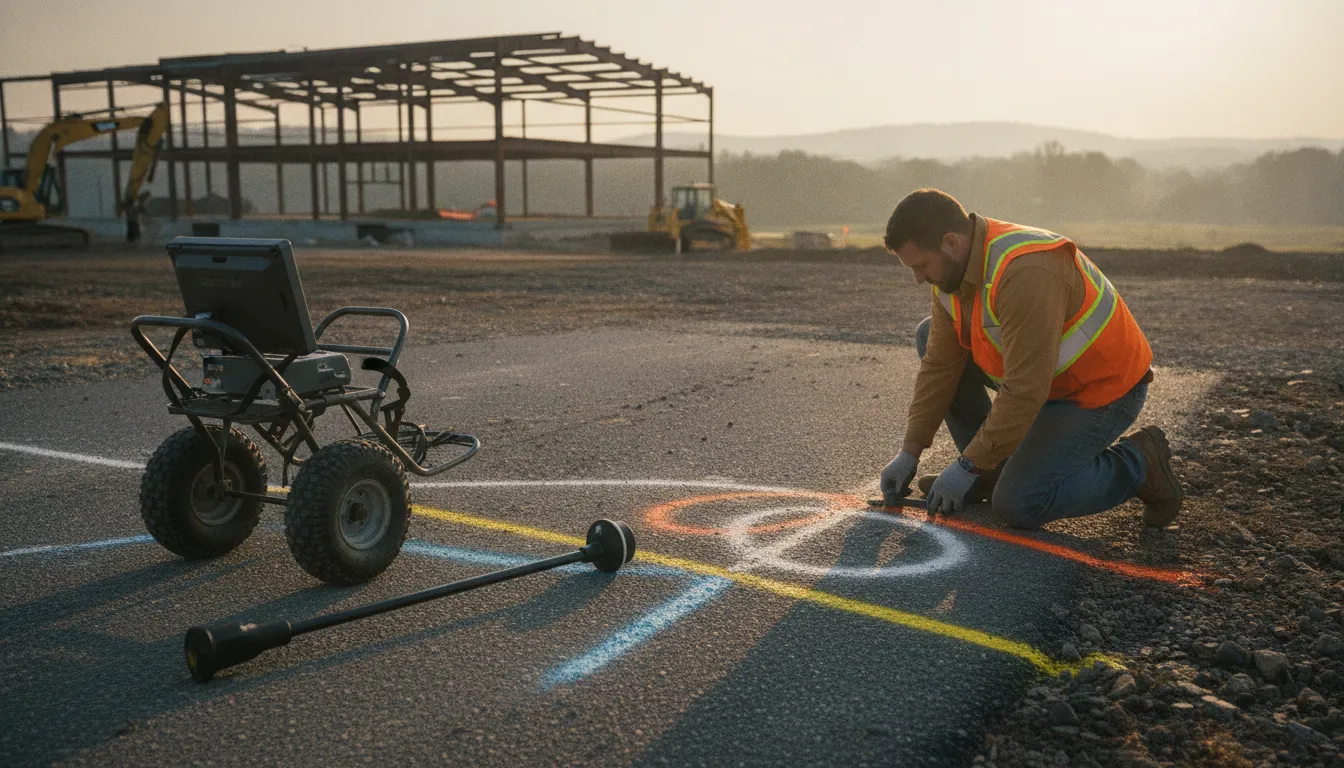
How often should utilities be relocated? For a field team, the useful answer is not a calendar date. Refresh a locate when the ticket is aging out, the marks no longer match the ground, or the work itself has changed. In Virginia, a public locate notice is valid for 15 working days, and illegible marks require a re-mark request. A private locate has no matching statewide clock. Treat that visit as current only while the same area, the same methods, and the same site conditions still apply.
Request a private locate review
This guide is for superintendents, project engineers, and excavators who already have marks and need to decide whether those marks still support the next shift. It separates a refresh from a new scope. It also separates public re-marking through Virginia 811 from a return visit for private lines. It does not replace the statute, the ticket, or a site-specific judgment.
How often should utilities be relocated on an active site?
Ask three questions before the next excavation. Is the public ticket still inside its valid window? Can the crew still read the marks? Does the planned dig still match the area that was located?
If the answer to any of them is no, stop and update the information before the bucket goes in the ground. A locate is a record of one area at one time. Paint fades. Grading covers it. A revised drawing can move the trench outside the marks you already have. None of those changes announce themselves on a schedule.
"Relocated" is easy to misread. On a highway or development project, relocating a utility can mean physically moving a line so the new work can be built. The Federal Highway Administration notes that this kind of relocation often has to happen before the highway contractor mobilizes, and unknown conflicts are a common source of delay. That is a design and coordination problem.
On an active dig, the more common question is narrower. Should the existing marks be refreshed, or should the team order a new locate because the work changed? This article answers that field question. Physical relocation of a live line is a utility-owner decision, not something a locator decides from paint.
There is also no single interval that fits every private locate. A one-day fence install and a six-month site package do not age the same way. Use the triggers below, then confirm anything that is jurisdiction-specific with the notification center or the utility owner.
What the Virginia public-locate window actually says
Virginia does set a clock, and it applies to the excavator's notice to the notification center, not to every private mark on a private site.
Under Code of Virginia § 56-265.17(D), an excavator's notification is valid for 15 working days from 7:00 a.m. on the next working day after the locate request. It can also run 15 working days from a scheduled excavation date given to the notification center, whichever is later. Three working days before that period ends, or any time the line-location markings become illegible. An excavator who still intends to dig must contact the notification center and request re-marking.
The operator is required to re-mark as soon as possible. The re-mark must be completed within 48 hours from 7:00 a.m. on the next working day after the re-mark request. That re-mark is then valid for another 15 working days, again counted from 7:00 a.m. on the next working day after a locate request.
Section 56-265.24(B) puts the same duty on the person doing the work. If markings become illegible because of time, weather, construction, or any other cause, that person notifies the notification center. The notice counts as an extension under the earlier section.
Virginia 811's ticket guidance splits that duty into two request types. An Update is for work that will not be finished by 7:00 a.m. on the 15th working day. Ask for it on the third working day before the period ends. A Re-mark is for marks that have become illegible. It can be requested during the life of the ticket, up to three working days before the 15th working day. Either request produces a new request number and another 15-working-day cycle. A normal locate is also expected to cover about a 15-working-day excavation window and not more than one-third of a mile.
Read those numbers as public-ticket rules. They are not a promise that paint stays visible for 15 days, and they are not a private-locate expiration date. Maryland, Washington, DC, and North Carolina set their own notice rules. If the project crosses a state line, check that state's notification center instead of copying the Virginia count.
Which site changes mean the marks are no longer current?
Time is only one trigger. A ticket can still be inside its window while the ground no longer matches the locate. Treat any of the following as a reason to pause and reassess before excavation continues.
| What changed | Why the old locate may not hold | Typical next step |
|---|---|---|
| Marks are faded, paved over, or graded away. | The crew cannot see the line the locator recorded. | Request a public re-mark through 811. Ask for a private revisit if private lines were marked. |
| Heavy rain, snow, or traffic wore the paint off. | Illegible marks are a statutory trigger in Virginia, not a judgment call. | Notify the center. Do not dig from memory of yesterday's colors. |
| The trench, bore, or footing moved outside the marked area. | The locate covered a defined area, not the whole parcel. | Treat it as a new scope. Order a new locate for the new limits. |
| Depth, method, or sequence changed. | A shallow hand dig and a deep bore do not share the same risk. | Review whether the original methods still answer the question. |
| The ticket is inside three working days of day 15. | Virginia requires the update request before the window closes. | Submit an Update if excavation will continue. |
| A new contractor or crew takes the area. | The new crew did not see the original marks or the walkthrough. | Re-walk the area. Refresh anything they cannot verify. |
Weather belongs in that list because the statute names it. A storm that leaves the paint readable may not require a new private visit. A storm that leaves blank asphalt does. Construction itself is also named. Tracked equipment, milling, and stone placement can erase a morning's marks by lunch.
Faded color is a stop-and-verify condition, not a prompt to guess the utility from whatever paint remains. The color guide covers how to read what is still visible. This timing guide only needs the decision: if the crew cannot point to a clear mark, the locate is not current.
Keep the public and private checks separate. An 811 update refreshes member operators who were notified. It does not refresh a private electric lateral, an irrigation main, or a site fiber line that was never on that ticket. If both were part of the original plan, both need their own follow-up.
When is a refresh different from a new scope?
A refresh repeats a locate for the same work. Same limits, same depth question, same methods, newer marks. A new scope is a different question. The drawing moved, the excavation got deeper, or the sequence now crosses an area nobody walked.
Use a refresh when:
- The crew is still digging inside the original limits.
- The only problem is age, weather, or marks that can no longer be read.
- The ticket needs an Update or a Re-mark so the public window stays valid.
- Private marks from the last visit are gone, but the area of concern did not change.
Order a new locate when:
- The work area expanded, shifted, or was divided among crews.
- A change order added a utility crossing, a deeper bore, or a new structure.
- The original locate excluded an area the team now plans to open.
- Records and paint disagree, and nobody can say which one matches the revision.
That revised-scope review has its own checklist in the guide to utility locating after scope changes. Use it when the plans moved. Stay here when the plans held and the marks did not.
Do not stretch an old private locate across a new limit to save a visit. A map or a set of marks answers the area that was investigated. Outside that area, the earlier work is background, not clearance. If the team needs the new limits documented, ask for a new visit and say what changed.
How a private locate return visit differs from an 811 re-mark
Public re-marking follows the notification center. The excavator contacts Virginia 811, the member operators or their contract locators respond, and the positive response system records the status. SafeLine does not re-mark those public lines and does not control that clock.
A private return visit is a separate request. It covers lines the ticket does not mark, on the area the project team defines. The private locating versus 811 page is the short version of that split. The longer gap list lives in the guide to what 811 does not cover. If you are still deciding whether the first private visit was needed, start with when to request a private locate instead of this refresh guide.
On a return visit, tell the locator what changed since last time. Useful notes include:
- The date and limits of the last locate, plus any sketches or files you still have.
- Which marks were destroyed, and by what: rain, milling, fill, or traffic.
- Whether the work area is the same or has moved.
- Any new exposures, potholes, or conflicts the crew has already found.
Electromagnetic locating and ground penetrating radar answer different parts of that request. EM tracing follows conductive lines that can carry a signal. GPR can help where the target is non-metallic or will not take a signal, but soil, moisture, depth, and the surface all change what the scan can show. A return visit might repeat one method, add the other, or both. The comparison of GPR and electromagnetic locating explains the choice. Neither method certifies that every line was found, and neither produces a guaranteed depth.
SafeLine's private utility locating work is scoped to the area and the question you define. Ground penetrating radar is used where it fits that question. If the project needs a file the next crew can open, utility mapping and documentation can record the findings. A map still has a date. It does not stay current by itself after the site is regraded.
What should the project file show before digging resumes?
A current locate is easier to defend when the file shows why the team trusted it. Before the next shift, a superintendent should be able to point to each of these.
- The active public ticket number, the date it became valid, and the date the 15-working-day window ends, if the work is in Virginia.
- Positive responses showing which operators marked, cleared, or still owe a response.
- Photos of the marks that the crew will actually use, taken after the last weather or grading event.
- The private locate date, the limits that were walked, and the methods used.
- A note that the current drawings match those limits, or a recorded decision to order a new scope.
- The name of the person who walked the area with the crew that will dig.
If any line is missing, the honest status is that the locate is incomplete for today's work. That is a scheduling fact, not a criticism of the last locator. Ticket responses, private visits, and plan revisions rarely land on the same day.
Store the private deliverable with the ticket, not in a separate inbox. A KMZ or a marked plan helps the next foreman only if they can find it before they dig. When the file and the paint disagree, stop and reconcile them. Do not average the two.
Teams planning the first visit, rather than a refresh, can use the private utility locating planning guide for scope and records. This page assumes that visit already happened.
How should crews handle a multi-week excavation?
Long jobs fail the "we already called" test. A site that runs for a month can cycle through more than one Virginia public window. Build the refresh into the look-ahead instead of discovering a dead ticket on the morning you need to dig.
A practical rhythm for Virginia public locates:
- When the ticket is issued, write the end of the 15-working-day period on the look-ahead.
- Three working days before that date, decide whether excavation in that area will continue.
- If it will, submit the Update. If the marks are already unreadable, submit the Re-mark sooner. Do not wait for day 15.
- Hold mechanized work until the new responses are posted and the new marks are on the ground.
- If the work area for the next two weeks is larger than the original ticket, break it into a new request instead of stretching the old one. Virginia 811 also expects a normal locate to stay within about one-third of a mile.
Private locates do not follow that count. Review them at the same look-ahead meeting anyway. Ask whether the private marks are still visible and whether next week's work stays inside the limits already walked. If either answer is no, schedule the return visit before the crew is standing on the new area.
Hand the refreshed information to the people who dig, not only to the trailer. A ticket number in the office does not help an operator who is looking at blank ground. Walk the new marks. Confirm the colors still match the work. Note anything the locator could not trace.
Emergency work is a different path under the statute, and it is not a reason to skip the record. If you are dealing with an active damage or a sudden exposure, use the emergency process for your notification center and call the affected operator. A planned refresh is for work you can see coming.
What this timing guide does not decide
Some neighboring questions sound similar and are already answered elsewhere. Keeping them separate protects you from using the wrong rule.
- Whether the project needed a private locate in the first place is a coverage question, not a timing question.
- How to read each paint color is a marking question. Refresh timing only cares whether the mark is still legible and still inside the work area.
- How to review a change order is a scope question. Link that guide when the plans move.
- How to choose between GPR and electromagnetic locating is a method question. Mention the methods when a return visit needs them, then send the reader to the comparison.
- Whether a line must be physically moved for a road or building is a utility-owner and design question. A locator's refresh does not relocate the pipe.
SafeLine can help a project team revisit a private locate in Virginia, Maryland, Washington, DC, and North Carolina when the earlier visit no longer matches the work. The company does not set the public ticket clock, does not guarantee a clear site, and does not provide a full subsurface utility engineering program. Findings are limited to the area, access, and methods of that visit.
If you want a second set of eyes on an aging private locate, describe the last visit, what destroyed the marks, and whether the limits changed. That is enough to tell a refresh from a new scope.
Frequently asked questions
How often should utilities be relocated during a long job?
Refresh them when a trigger hits, not on a guessed weekly schedule. In Virginia, request a public Update three working days before the 15-working-day window ends if digging will continue. Request a Re-mark sooner if the marks are illegible. Review private marks on the same look-ahead, and book a return visit when they are gone or the work has moved.
Do private utility marks expire after 15 working days?
No. The 15-working-day period in § 56-265.17 applies to the excavator's notice to Virginia's notification center. A private locate is not that notice. Treat private marks as current only while the same area and site conditions still match the visit. Weather, grading, or a new work limit can make them stale sooner.
Who re-marks 811 lines versus private lines?
Public member utilities are re-marked through the notification center after the excavator requests an Update or a Re-mark. A private locating firm does not refresh those public marks. If the project also has private lines, ask the private locator for a separate return visit and describe what changed.
What if the plans changed but the marks still look fresh?
Fresh paint in the old location does not cover a new trench. If the limits, depth, or method changed, treat the work as a new scope and order a locate for the revised area. The change-order guide walks through that review. A refresh is only for the same work with marks that need to be renewed.
Does a saved map replace a new field visit?
A map, KMZ, or marked plan is a record of an earlier investigation. It helps the next crew understand what was found. It does not update itself after milling, fill, or a revised drawing. If the crew cannot verify the marks on the ground, schedule a visit instead of digging from the file.
Plan the next locate before the marks fail
Put the public window on the schedule, walk the marks after weather and grading, and separate a same-area refresh from a revised scope. That is the practical answer to how often a locate should be renewed.
Contact SafeLine about a return visit
Call (866) 677-2335 or send the last locate date, the work limits, and what changed on the site. We will tell you whether the request is a refresh of the same area or a new private locate.